


You send a colleague a proposal on Monday. By Wednesday there is no reply. Nothing has actually happened, but something has started. You catch yourself rereading the email and finding it weaker than you thought. You remember that this colleague once took credit for your idea. You decide not to mention the next idea you had. By Thursday evening you feel a low, shapeless dread, and if someone asked what you are afraid of, you could not say.
Look at what happened in those three days. One small, reasonable doubt about another person (”they’re ignoring me”) turned into doubt about yourself, then into an old grudge, then into holding back from the future, and finally into fear. None of these steps felt like a choice. Each one felt like simply noticing the truth. Then on Friday the colleague replies: they were off sick, and they love the proposal. The dread is gone within a minute, and so are the grudge, the self-doubt and the hesitation, all at once.
That is the pattern this framework is built to explain. The states we usually treat as separate problems, such as fear, resentment, envy, self-criticism, suspicion and the inability to say no, are connected. They move together. They spread from one to the next along predictable paths, and they can be undone along the same paths. Most importantly, they all lead to one place, and their absence leads to another.
The framework’s central claim is simple: love is what remains when the shadows leave. Love is not something you produce by effort. It is the natural state at the centre, and fear is what fills the centre when enough of the surrounding qualities have turned dark. So the practical question is never “how do I love more?”, which no one can act on. It is “which shadow came in, and where did it come from?”, which has a precise answer.
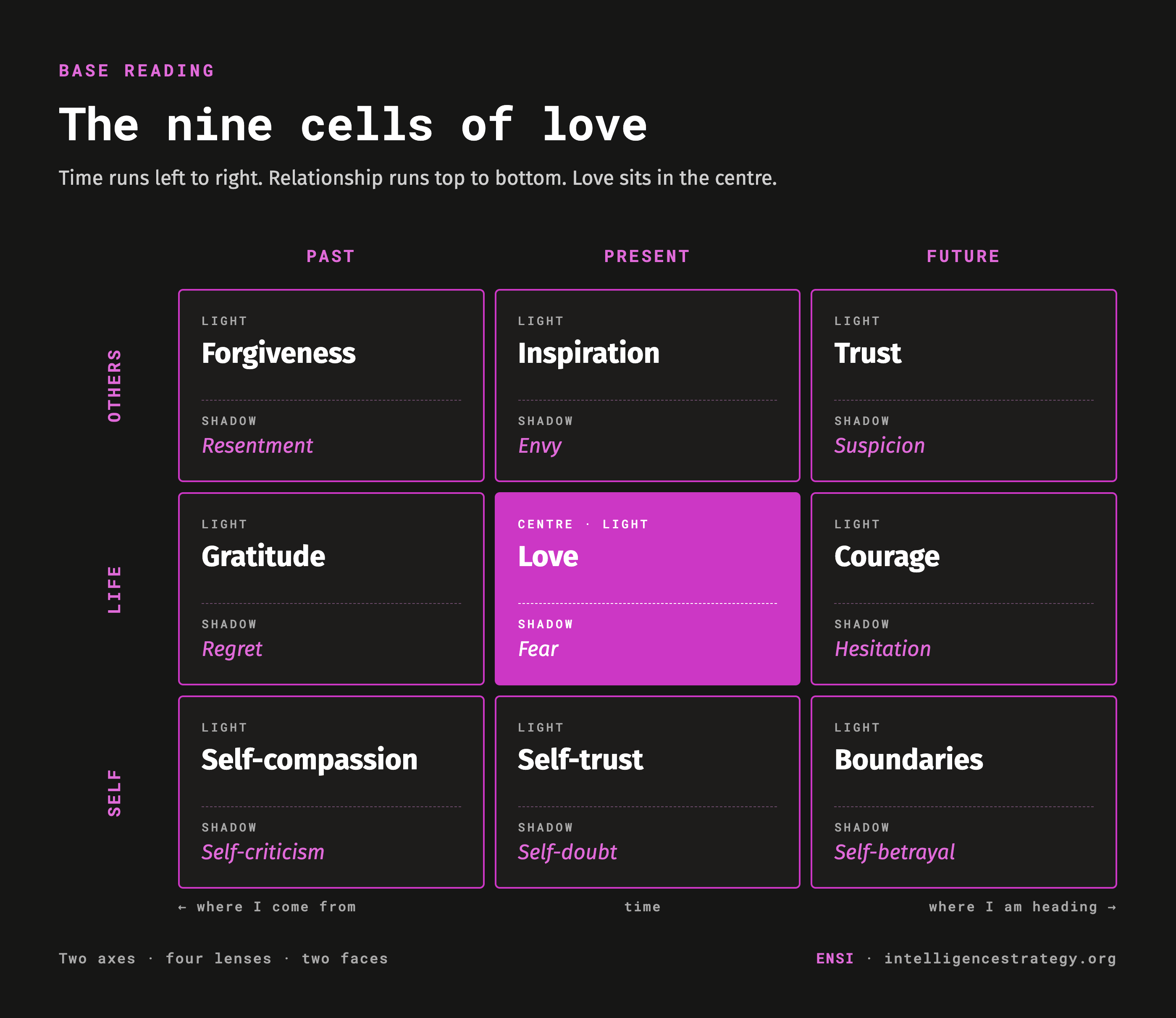
The map has two axes. The horizontal axis is time: past, present, future. The vertical axis is relationship: other people at the top, life itself in the middle, and yourself at the bottom. Two axes with three positions each make a 3×3 grid of nine cells. Each cell holds a quality with a light face and a shadow face. Love is in the centre, in the present, facing life, and its shadow is fear.
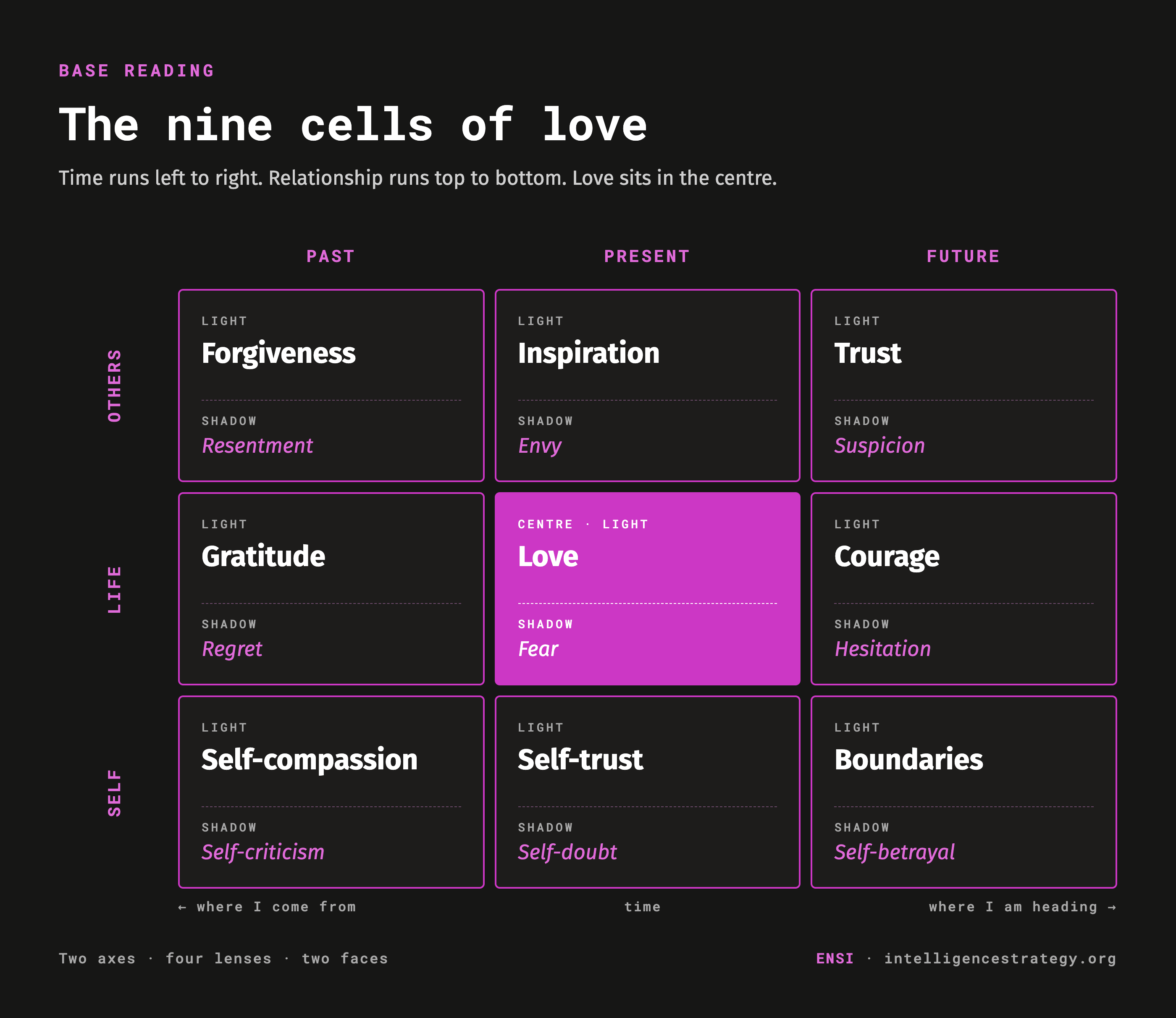
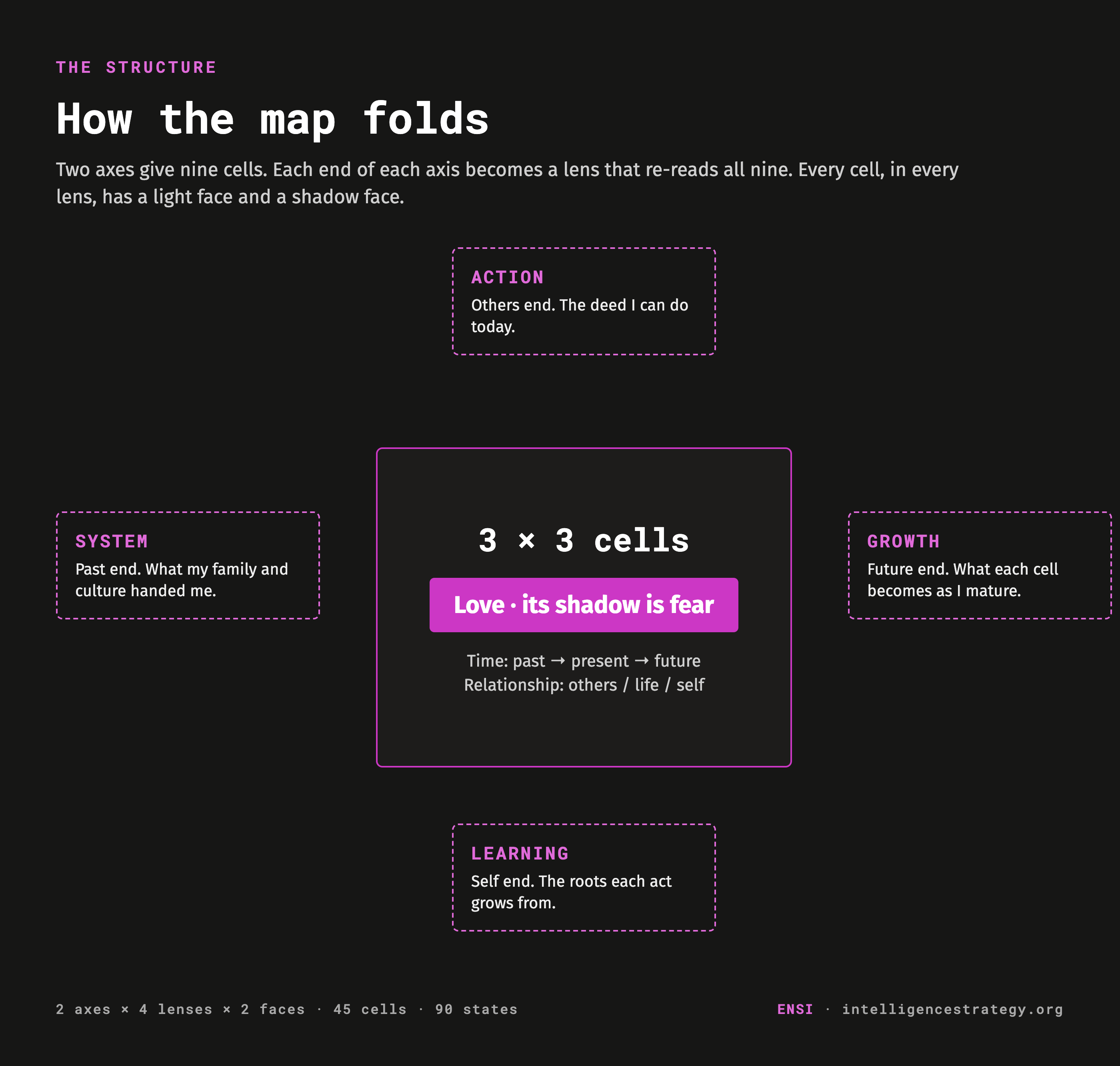
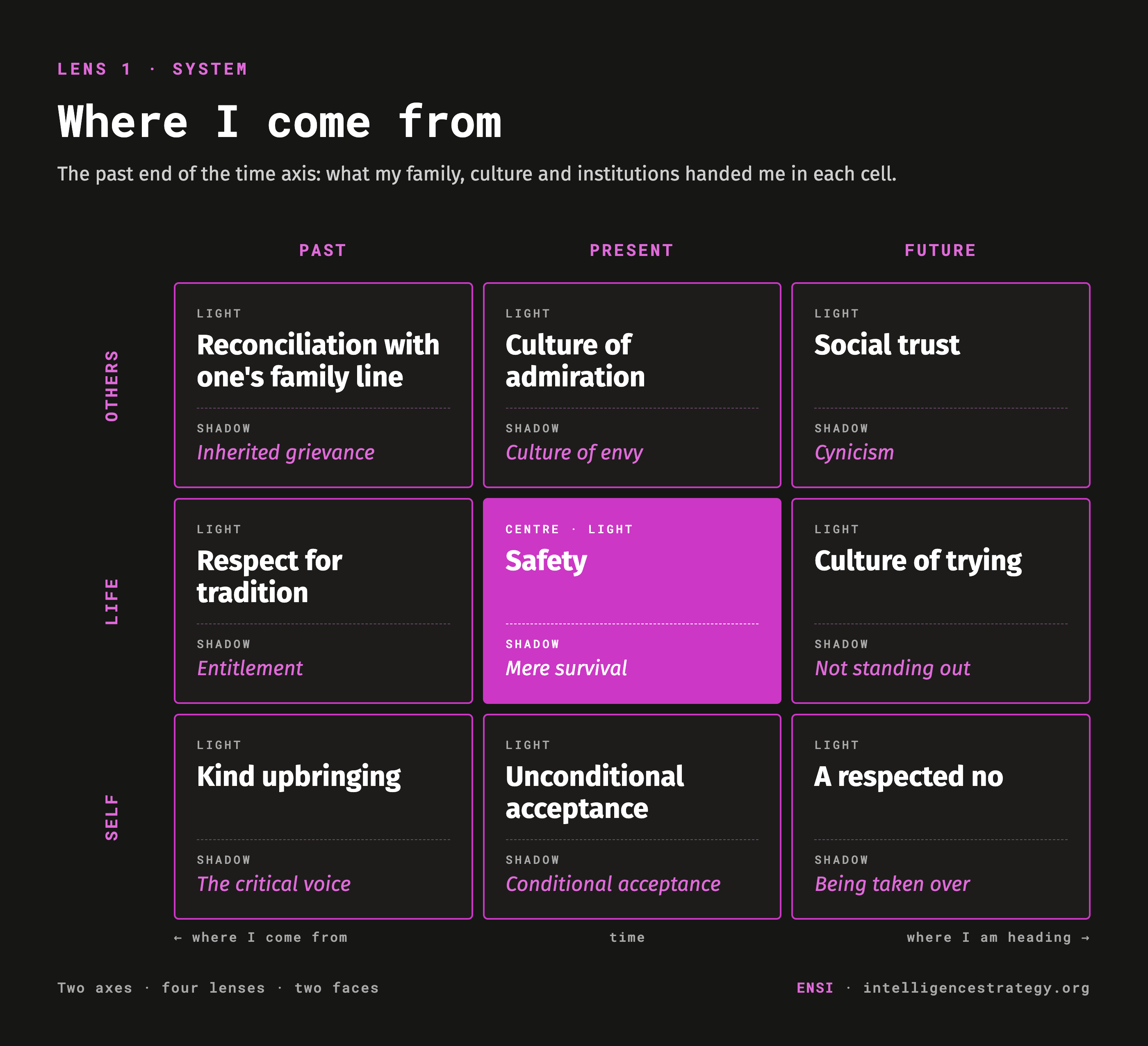
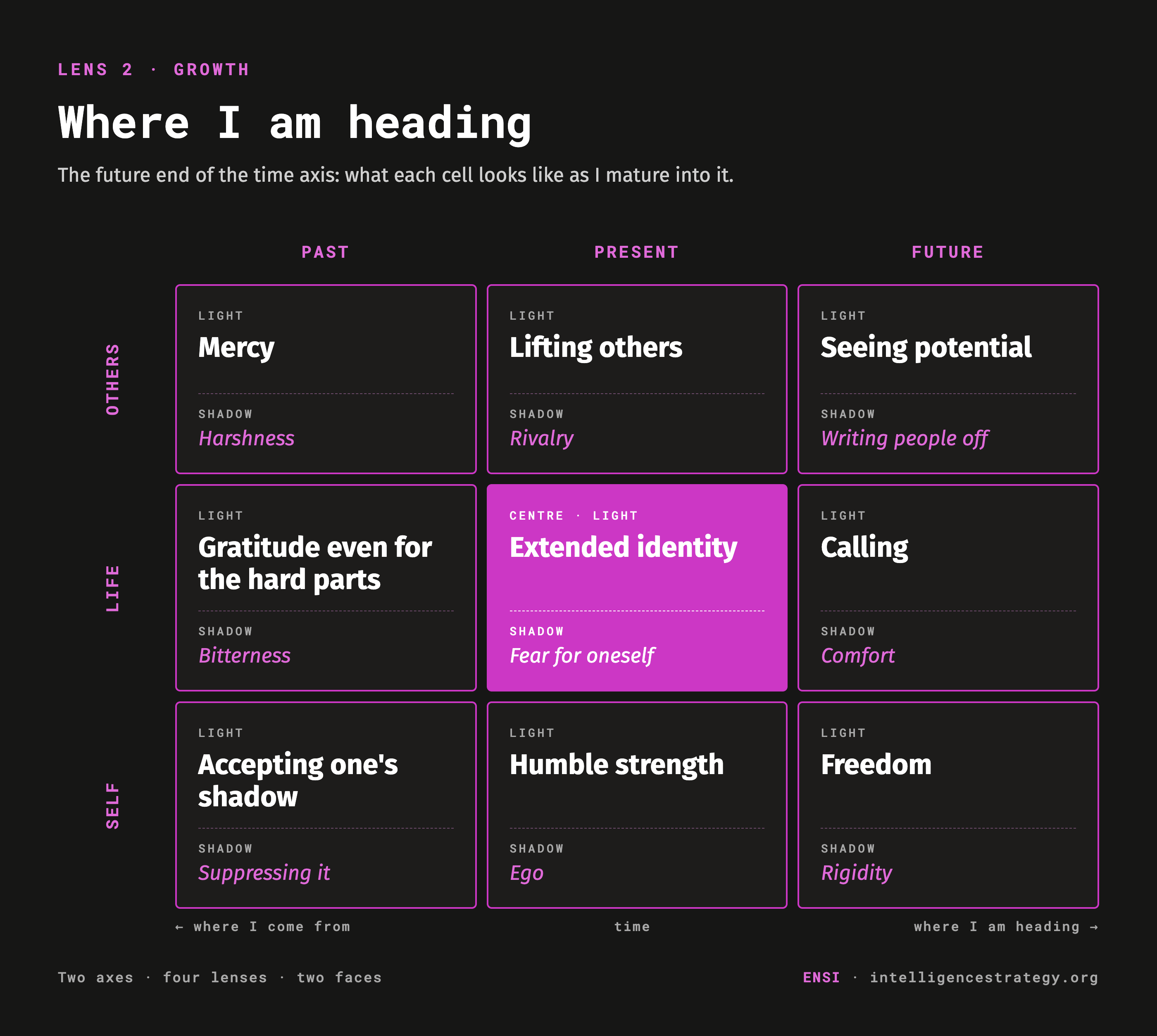
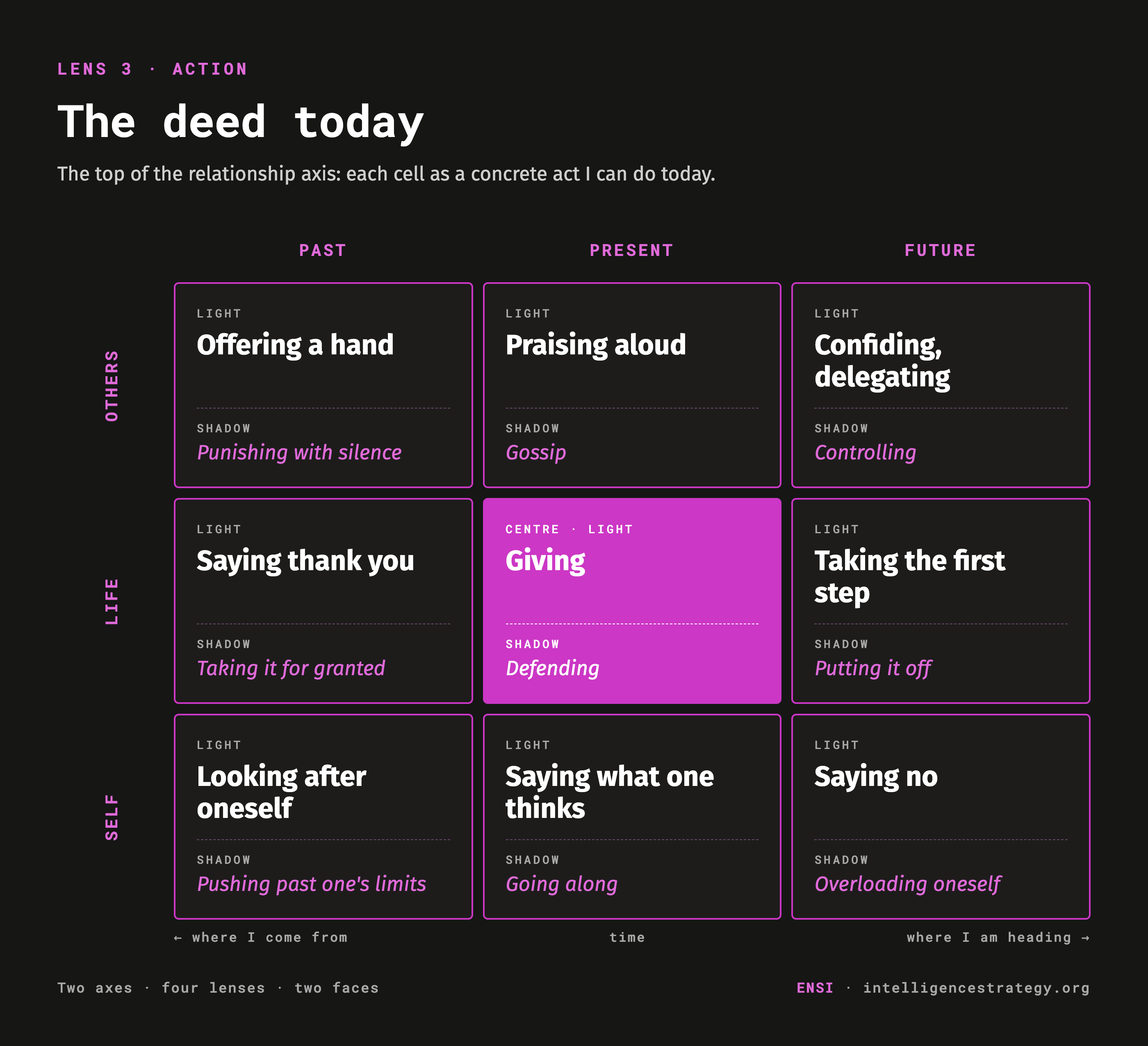
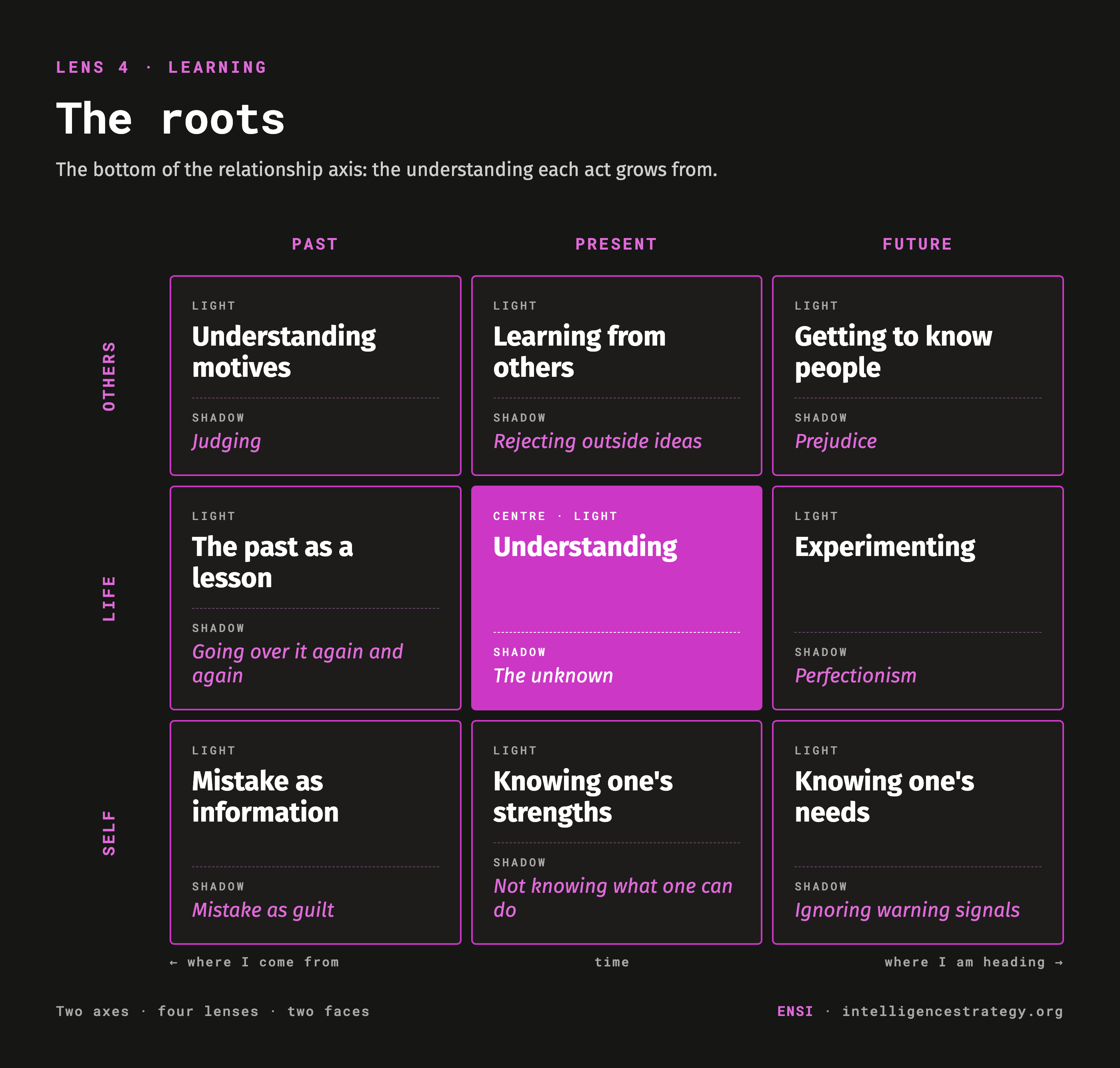
Then the map folds. Each end of each axis becomes a lens that re-reads all nine cells. The past end becomes the System lens: what my family, culture and institutions handed me. The future end becomes the Growth lens: what each cell becomes as I mature. The top becomes the Action lens: each cell as something I can do today. The bottom becomes the Learning lens: the understanding each act grows from. Two axes, four lenses, two faces. The four lens tables are at the end.
The idea draws on older maps. Aristotle placed each virtue between two vices. Buddhist teaching gave each quality of the heart a “far enemy” (its opposite) and a “near enemy” (its counterfeit). The German values square holds that every virtue goes bad without a sister virtue. Psychologists have measured our orientations to past, present and future, and have shown that good states feed one another in upward spirals. This framework puts those insights on one grid and adds rules for how states spread. The principles below set out those rules. Three ordinary situations then show them at work, and a final section explains which older maps the framework borrows from and where it differs.
The ten principles at a glance
Love is the remainder. It is not produced; it is what is left when the shadows go.
Every quality is a stance toward someone at some time. Two axes, time and relationship, place it.
Every cell has two faces. Each light quality has a shadow, and often a counterfeit that looks like the light.
Fear is the centre’s shadow. It is fed from the edges, mostly from the future column.
Shadows travel along rows and columns. A dark cell darkens its neighbours in time or in relationship.
The fall starts with a defensible shadow. Nobody falls in one step, and every step feels justified.
The return starts with the cheapest light act. You cannot jump to the centre; you light one cell and its neighbours follow.
Diagnose in one lens, treat in another. System and Learning explain where a shadow came from; Action and Growth show the way out.
Balance, not maximum. A light quality without its neighbours turns into a shadow of its own.
The map works at every scale. The same nine cells describe a person, a couple, a team and a country.
1. Love is the remainder
Metaphor: Love is the sky, and the shadows are clouds. You don’t build the sky; you wait for the clouds to move.
Definition:
Love is not an output you can produce by trying harder.
It is the state a person returns to when nothing is blocking it.
The eight cells around the centre are the ways it gets blocked.
Each blocked cell takes a little of the centre away.
When enough of them are dark, the centre is filled with fear instead.
The work is therefore removal, not production.
Why it holds:
Fredrickson’s broaden-and-build research shows positive states widen attention and build resources, so they need room rather than force.
Studies of trying to be happy (Mauss and colleagues, 2011) found that valuing happiness too hard can lower it.
Neff’s work on self-compassion shows that removing self-attack does more for motivation than adding pressure.
Contemplative traditions from Christian mysticism to Buddhism describe love as uncovered rather than made.
Clinically, most effective therapies for anxiety and depression work by reducing avoidance and threat, not by adding positive feeling directly.
How to build with it:
Stop asking “how can I feel more love?” and ask “what is in the way right now?”
Treat warmth that returns on its own as the sign that a cell has cleared.
Measure progress by fewer dark cells, not by more intense feelings.
In teams and families, remove obstacles before running “culture” programmes.
Expect love to come back by itself once the blocking cells are lit.
2. Every quality is a stance toward someone at some time
Metaphor: Each feeling has an address: a person and a time.
Definition:
Every inner quality points somewhere.
Resentment points at another person, in the past.
Courage points at life, in the future.
Self-trust points at yourself, in the present.
Once you know the address, you know which cell you are dealing with.
The two axes turn a vague mood into a precise location.
Why it holds:
Zimbardo and Boyd’s Time Perspective Inventory (1999) shows people differ reliably in how they lean toward past, present and future.
Their “balanced” profile, warm toward the past, open to the future and low on past regret, matches the light side of the time axis.
Rumination research (Nolen-Hoeksema) ties low mood to a fixation on the past, and worry research (Borkovec) ties anxiety to the future.
Erikson’s stages of development pair each period of life with a stance toward self or others, such as trust versus mistrust.
Lieberman’s affect-labelling studies show that naming a feeling precisely reduces its intensity.
How to build with it:
When a feeling arrives, ask: toward whom, and when?
Write the cell down rather than the mood (”Others · past” instead of “bad day”).
Notice which column you live in most; anxious people live on the right, regretful people on the left.
Use the address to pick the remedy; a past problem needs a past-column act.
Teach children the two questions early; they are simpler than any list of emotions.
3. Every cell has two faces
Metaphor: Every cell is a coin, and some coins are forged.
Definition:
Each cell has a light quality and a shadow quality.
The shadow is usually the plain opposite: forgiveness and resentment, trust and suspicion.
Some shadows are subtler and look like the light.
Appeasement can look like forgiveness, and naivety can look like trust.
Buddhist teaching calls these counterfeits “near enemies”.
A cell is only truly light when it is neither its opposite nor its imitation.
Why it holds:
Buddhaghosa’s Visuddhimagga gives each of four heart qualities a far enemy (its opposite) and a near enemy (a lookalike); for loving-kindness the far enemy is ill will and the near enemy is greed, often read today as clinging.
Aristotle’s Nicomachean Ethics places courage between cowardice and rashness, so there are two ways to miss it.
Van de Ven and colleagues (2009) separated “benign” envy, which motivates, from “malicious” envy, which wants to pull others down.
Forgiveness research distinguishes forgiving, which is internal, from reconciling, which depends on whether the other person is safe.
Clinical work on people-pleasing shows that submission can pass for kindness while hiding resentment.
How to build with it:
For each cell, write its opposite and its counterfeit.
Ask whether a “light” state costs you your boundaries; if it does, it is probably a counterfeit.
Forgive without promising to trust; trust is earned in a different cell.
Admire without comparing; inspiration that leaves you smaller has turned.
Use the counterfeit test when someone praises you for a quality that is hurting you.
4. Fear is the centre’s shadow
Metaphor: Fear is the centre filling with water as the walls around it leak.
Definition:
Fear does not usually arrive by itself.
It shows up after several edge cells have gone dark.
Most of it comes from the future column: suspicion, hesitation, self-betrayal.
Some of it comes from the past column, as regret and self-criticism stored up as threat.
Fighting fear head-on rarely works, because it is made of many small things.
Fear fades when the edge cells feeding it are lit.
Why it holds:
Kahneman and Tversky showed that potential losses weigh about twice as much as equal gains, which pulls attention toward future threats.
Borkovec’s work on worry shows it is mostly about the future and keeps itself going by avoidance.
Exposure therapy, the best-supported treatment for anxiety (Foa and Kozak’s model), works by approaching specific feared things, which in this map means lighting particular cells.
Social-baseline theory (Coan and colleagues, 2006) found that holding a trusted person’s hand reduced the brain’s threat response, showing that trust in Others · future dampens fear.
Popular spiritual writing has long called love and fear the two root emotions; this framework turns that idea into a map.
How to build with it:
When afraid, look first at the right-hand column.
Name the most specific dark cell feeding the fear.
Light that cell with one act; do not argue with the fear itself.
Check whether you are low on trust in others; it is often the quickest lever.
Accept some fear as information about real danger, and still ask which cell it lives in.
5. Shadows travel along rows and columns
Metaphor: Shadows spread like damp in a wall: through whatever they touch.
Definition:
A dark cell does not stay dark alone.
Along a row it moves through time: resentment about the past becomes suspicion about the future.
Down a column it moves through relationship: envy of another becomes doubt about yourself.
Light spreads along the same paths: gratitude about the past makes courage about the future easier.
This is why one small event can change a whole day.
And it is why one small act can repair it.
Why it holds:
Fredrickson and Joiner (2002) found that positive emotion and broad-minded coping built on each other over five weeks, an “upward spiral”.
Burns and colleagues (2008) replicated the spiral and found positive feeling and trust in others feeding each other.
Depression research describes the matching downward spiral, in which low mood narrows thinking and narrow thinking deepens low mood.
Social comparison research (Festinger 1954; Tesser’s self-evaluation model) shows how feelings about others move down into feelings about oneself.
Gottman found that contempt (the Others row) predicts the breakdown of the whole relationship, not just one conversation.
How to build with it:
When one cell goes dark, check its row and column neighbours next.
Interrupt the spread early, before it reaches the centre.
Use the same paths for repair: a light act in one cell will help its neighbours.
Keep a short log of which paths you usually travel; most people have two or three.
In groups, look for the cell where a shadow first entered, not the loudest one.
6. The fall starts with a defensible shadow
Metaphor: No one falls down a cliff; they walk down a staircase where each step looks like the last.
Definition:
People rarely move from love to fear, or from good to bad, in one jump.
The first shadow is almost always small and reasonable.
It is a grudge that was earned, a caution that was wise, or an exception that brought results.
Each later step is justified by the one before it.
By the time the centre has turned, the path looks like plain realism.
That is why the first step matters more than the last.
Why it holds:
Diane Vaughan’s study of the Challenger disaster named “normalisation of deviance”: each accepted anomaly made the next one easier to accept.
Ervin Staub’s The Roots of Evil (1989) describes a “continuum of destruction” in which each harmful act lowers the bar for the next.
Christopher Browning’s Ordinary Men (1992) shows ordinary policemen becoming killers through conformity and small steps.
Bandura’s moral disengagement theory lists how people justify each step: euphemism, comparison, and spreading responsibility around.
Foot-in-the-door research (Freedman and Fraser, 1966) shows how agreeing to a small request makes a larger one more likely.
How to build with it:
Watch most closely the shadows you can easily justify.
Ask, when something feels “only realistic”, which cell it is darkening.
In organisations, list the exceptions you tolerate because they bring results.
Name the first step aloud; it is easiest to reverse.
Don’t wait for a big moment of failure; the fall is made of small ones.
7. The return starts with the cheapest light act
Metaphor: You climb back up the same staircase, one step at a time, starting with the nearest.
Definition:
You cannot jump back to the centre by deciding to love.
You can light one cell with one small, concrete act.
The cheapest act is usually in the Action lens: a thank-you, a plain question, a kind no.
Once that cell is lit, its neighbours become easier to reach.
The centre returns on its own when enough cells around it are light.
Repair is a sequence, not a leap.
Why it holds:
Behavioural activation, an effective treatment for depression, begins with small actions rather than with changing feelings first.
Gratitude studies (Emmons and McCullough, 2003) show a simple, regular act shifts well-being over weeks.
Gottman’s research shows “repair attempts” are what separate couples who last from those who don’t.
Small-wins research (Amabile and Kramer’s progress principle) found small daily progress the strongest booster of motivation at work.
Restorative justice reviews (Sherman and Strang, 2007) show that concrete acts of repair reduce reoffending and victims’ anger.
How to build with it:
Choose the smallest act that would light one cell today.
Prefer acts you can finish in under five minutes.
Start in the cell next to the worst one if the worst one feels too heavy.
Do the act before you feel ready; the feeling follows the act.
Notice which neighbour cell lightens next, and take that step too.
8. Diagnose in one lens, treat in another
Metaphor: The System lens tells you where the stone came from; the Action lens tells you how to lift it.
Definition:
Every cell can be read through four lenses.
System shows what I inherited, and Learning shows the belief underneath.
Growth shows the direction to mature in, and Action shows what to do today.
A shadow is often visible in one lens and fixable in another.
A critical voice is diagnosed in System, unlearned in Learning and replaced in Action.
Using only one lens leaves half the map unread.
Why it holds:
Wilber’s four quadrants (individual and collective, inner and outer) showed the value of reading one situation from several fixed angles.
Compassion-focused therapy (Gilbert) traces self-criticism to early experience (System) and treats it with new practice (Action).
Attachment research on “earned security” shows inherited patterns can be changed by later learning and relationships.
Cognitive-behavioural therapy pairs a belief (Learning) with a behavioural experiment (Action).
The ACE study (Felitti and colleagues, 1998) shows how strongly System-lens inheritances shape adult life, which is why they must be read.
How to build with it:
For a stubborn shadow, read it through all four lenses on one page.
Ask: who handed me this (System)? what do I believe (Learning)? where am I heading (Growth)? what can I do today (Action)?
Fix inherited shadows by unlearning, not by blaming.
Always end with an Action-lens step, however small.
Use the System lens on organisations to see what newcomers inherit.
9. Balance, not maximum
Metaphor: A light cell turned up too high starts to cast its own shadow.
Definition:
No cell should be pushed to its maximum alone.
Trust without learning about people becomes naivety.
Courage without boundaries becomes recklessness.
Forgiveness without self-compassion becomes self-erasure.
Each light cell needs its neighbours to stay light.
The centre is a balance point, not a peak.
Why it holds:
Helwig’s values square (1948), developed by Schulz von Thun, holds that every value needs a “sister value” or it degenerates, as thrift without generosity becomes stinginess.
Aristotle’s doctrine of the mean makes the same point for each virtue.
Grant and Schwartz (2011) reviewed evidence that even good traits and states show an inverted-U, harmful past a point.
Research on the “dark side” of forgiveness (McNulty, 2011) found that forgiving partners who kept offending led to more offences.
Zimbardo and Boyd describe a balanced time perspective, not a maximal one, as the healthy profile.
How to build with it:
For each light cell you value, name the neighbour that keeps it honest.
Pair trust with learning about people, and courage with boundaries.
Watch for virtues you are praised for; they are the likeliest to tip over.
In teams, balance cultures of kindness with cultures of candour.
Aim for the centre, not for any one cell.
10. The map works at every scale
Metaphor: The same nine cells, whether you’re drawing a person, a family or a nation.
Definition:
The framework is not only about individuals.
A couple has a shared Others · past: the hurts they have or have not repaired.
A team has a shared Others · future: whether it is safe to speak up.
A country has a shared System lens: how much strangers trust each other.
The same rules apply at each scale: shadows spread, and the way back is one cell at a time.
That is what lets one framework be used for everything.
Why it holds:
Edmondson’s research on psychological safety (1999) describes the team version of trust in Others · future.
World Values Survey data show large, lasting national differences in how many people say “most people can be trusted”.
Nunn and Wantchekon (2011) traced low trust in parts of Africa today back to the slave trade, a System-lens inheritance over centuries.
Gottman’s couple research and Gacaca and truth-commission work at national level both show repair in the past column.
Putnam’s work on social capital links trust between neighbours to how well institutions function.
How to build with it:
Run the nine questions for a relationship, a team or an organisation, not just for yourself.
Use the System lens to see what a group passes on to newcomers.
Look for the first shadow a group learned to tolerate.
Repair at the group’s scale: a public thank-you, a no-blame review, an honest account of the past.
Expect group repair to take longer, but to follow the same steps.
The framework at work: three ordinary situations
The principles are easiest to see in ordinary moments. Here are three, each starting in a different cell. In each image, the outlined pink badges show the fall, step by step, and the white badges show the way back.
The unanswered message
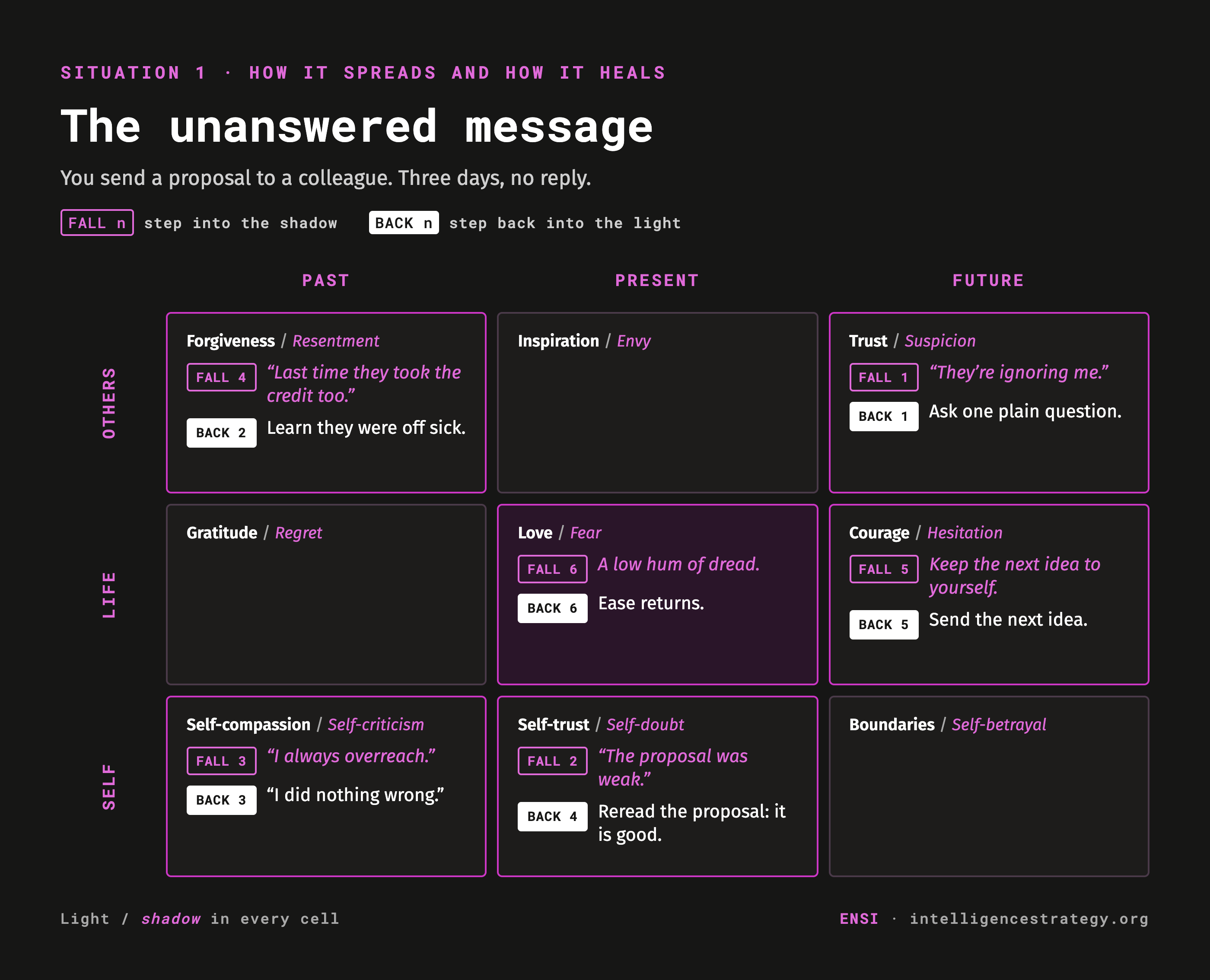
The situation. You send a proposal to a colleague. Three days pass with no reply.
How it spreads. The first shadow is in Others · future: “they’re ignoring me”, a small and reasonable suspicion (principle 6). It moves down the column into Self · present: you reread the proposal and it suddenly looks weak. It moves left along the row into Self · past: “I always overreach”. It climbs to Others · past, where an old grudge wakes up: last time they took the credit. Then it spreads right into Life · future: you decide to keep your next idea to yourself. By now the centre is fear, a dread with no clear object (principle 4).
The way back. Arguing with the dread won’t help. The cheapest light act is in the cell where it started: ask one plain question (”Did you get a chance to look?”). That is trust, done as an act (principle 7). The answer lights Others · past through the Learning lens: they were off sick, so there is nothing to resent. Self · past clears (”I did nothing wrong”), Self · present follows (the proposal is still good), and Life · future opens (you send the next idea). The centre comes back on its own (principle 1).
What the lenses show. Through the System lens, many people grew up in homes where silence meant disapproval, which is why an empty inbox lands so hard. The Learning lens supplies the correction: silence is usually about the other person’s day, not about you.
A friend’s promotion
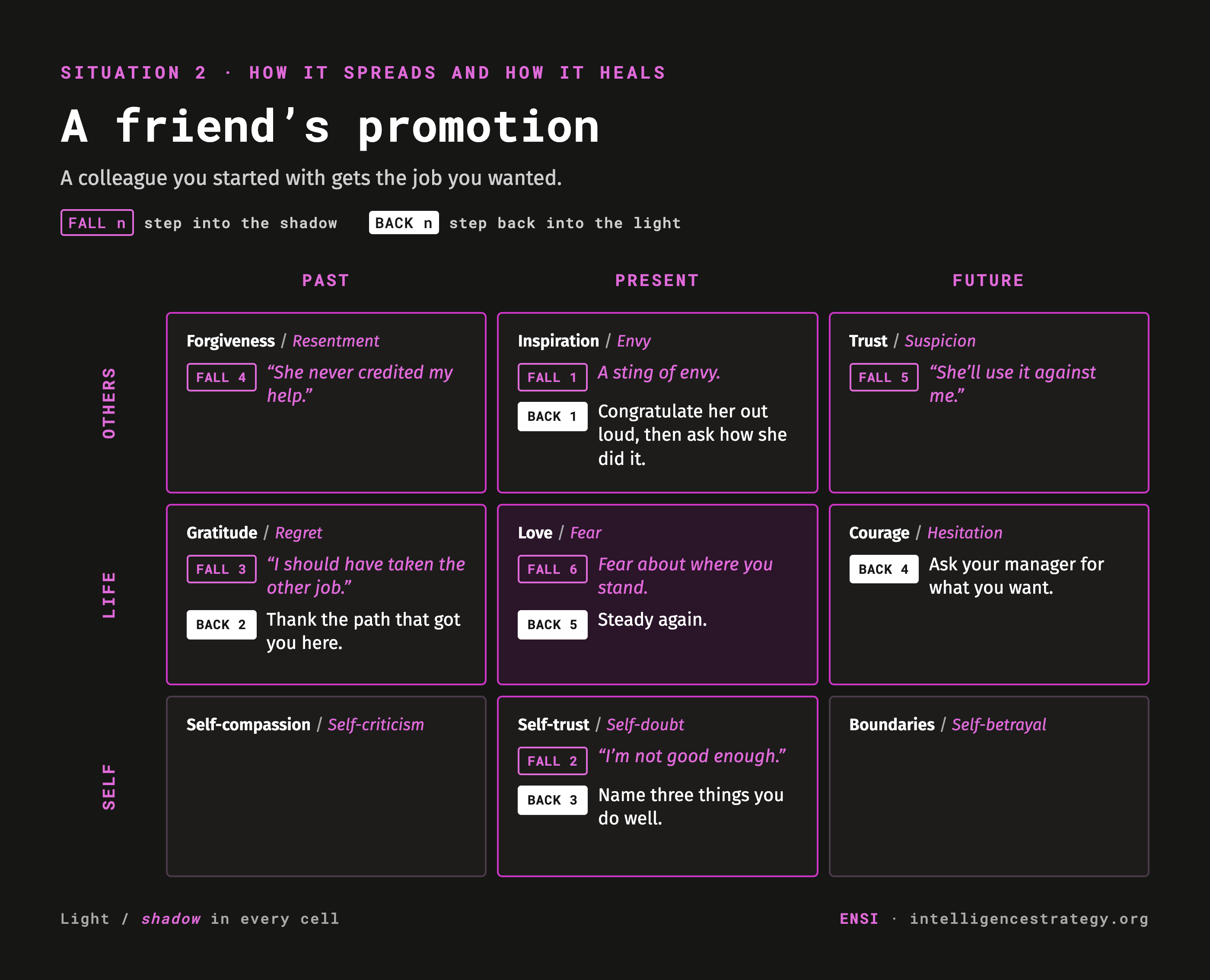
The situation. A colleague you started with gets the job you wanted.
How it spreads. The first shadow is in Others · present: a sting of envy where admiration could have been. Envy is the shadow of inspiration, and malicious envy is its worst form (principle 3). It drops down the column into Self · present: “I’m not good enough”. It moves left into Life · past: “I should have taken the other job”. It climbs to Others · past: “she never credited my help”. It spreads right into Others · future: “she’ll use her new position against me”. The centre fills with fear about where you stand.
The way back. Start in the cell where it began, with an Action-lens act: congratulate her out loud. Then use the Learning lens in the same cell and ask how she did it, which turns envy back into inspiration. That opens Life · past: be grateful for the path that brought you here, including the parts you would not choose again. Self · present comes back when you name three things you actually do well. Finally, Life · future: ask your manager for what you want. The centre steadies.
What the lenses show. The Growth lens names the real choice here, lifting others or competing with them. Teams and cultures that rank people against each other push everyone toward rivalry; the System lens shows how much of this envy was taught.
The family dinner
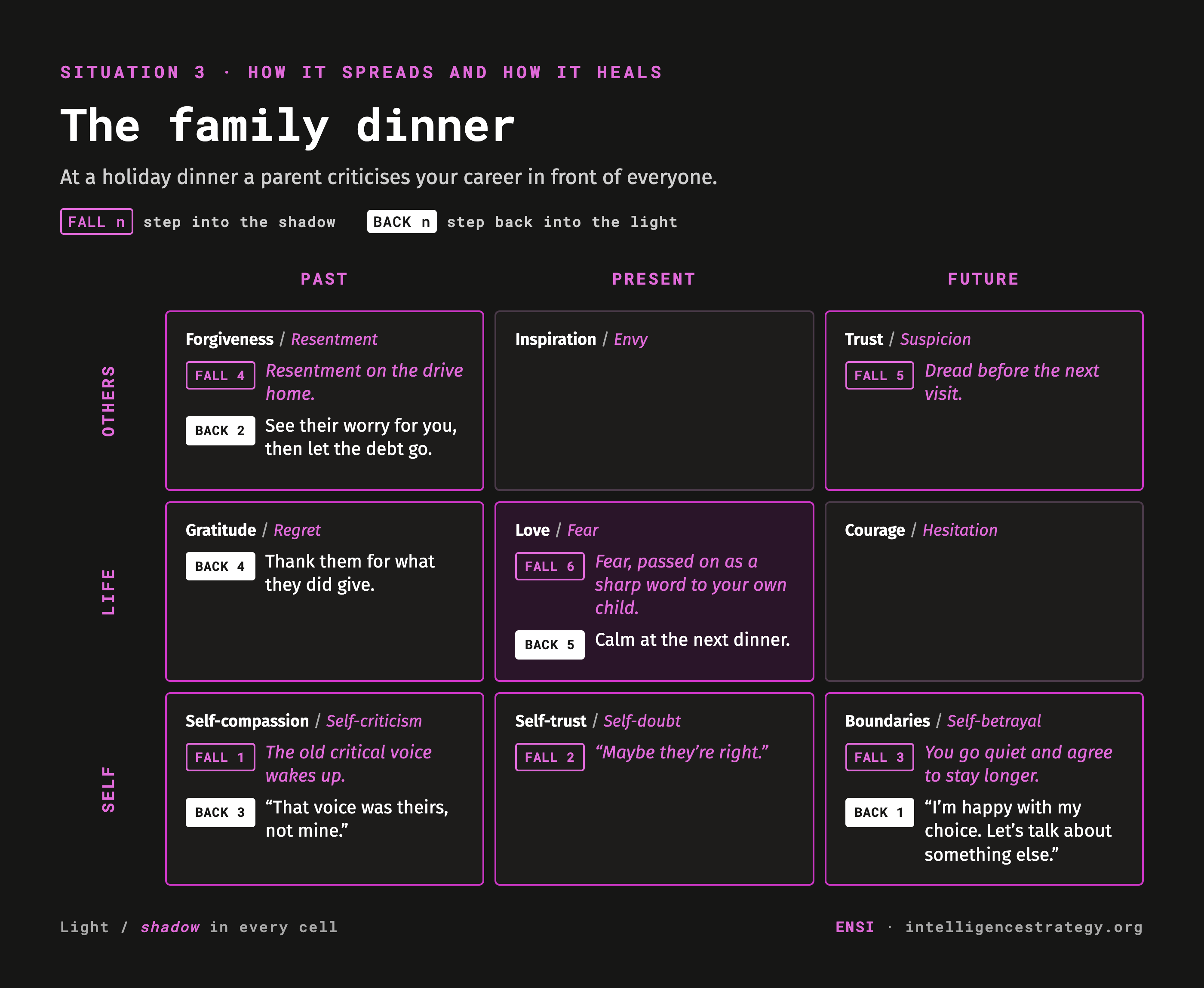
The situation. At a holiday dinner, a parent criticises your career choice in front of everyone.
How it spreads. This one starts in Self · past, read through the System lens: the critical voice you grew up with wakes up. It moves right to Self · present: “maybe they’re right”. Then to Self · future: you go quiet and agree to stay longer than you wanted, which is self-betrayal. It climbs to Others · past as resentment on the drive home, and spreads to Others · future as dread before the next visit. The centre is fear, and the next morning it comes out as a sharp word to your own child. That last step is the System lens at work: the shadow is passed to the next generation (principle 10).
The way back. The cheapest light act is in Self · future: one calm boundary (”I’m happy with my choice. Let’s talk about something else”). Then Others · past through the Learning lens: see that the criticism comes from their worry about your security, which is their own fear in their own centre. Then let the debt go. Self · past follows: “that voice was theirs, not mine”. Then Life · past: thank them for what they did give. The next dinner is calmer, and the child does not inherit the voice.
What the lenses show. The order matters here (principle 9). Forgiving before setting the boundary would have been appeasement, the counterfeit of forgiveness. The boundary comes first; the forgiveness that follows is real.
What this framework borrows, and what it adds
The framework stands on several older maps. Each one holds part of it:
Aristotle’s mean (Nicomachean Ethics) — shares: every virtue sits between two failures · adds here: a grid that links the virtues to each other.
Near and far enemies (Buddhaghosa, Visuddhimagga) — shares: each quality has an opposite and a counterfeit · adds here: placing them on axes of time and relationship.
The values and development square (Helwig, 1948; Schulz von Thun) — shares: every value needs a sister value or it degenerates · adds here: naming which neighbour cell is the sister.
Erikson’s psychosocial stages — shares: pairs of light and shadow, such as trust versus mistrust · adds here: treating them as states you move between daily, not just stages of life.
Zimbardo’s time perspectives — shares: stances toward past, present and future that can be measured · adds here: crossing time with relationship.
Wilber’s four quadrants — shares: reading one situation through several fixed angles · adds here: lenses that come from the ends of the map’s own axes.
Fredrickson’s upward spirals — shares: good states feeding each other · adds here: the specific paths, along rows and columns, by which they spread.
Karpman’s drama triangle and Emerald’s empowerment dynamic — shares: shadow roles (victim, persecutor, rescuer) with light counterparts (creator, challenger, coach) · adds here: a full grid in place of a single triangle.
“Love and fear” in popular spiritual writing — shares: love and fear as the two root states · adds here: a map of exactly how one turns into the other.
What this framework adds, taken together, is four things. It puts nine qualities on one grid with an address for each. It places love at the centre as what is left, rather than as a goal. It folds the grid into four lenses, so one map covers what was inherited, the direction of growth, today’s deed and the root belief. And it gives rules for movement: how shadows spread, where falls begin and how returns happen.
Using it: one map for everything
The method fits on a card. Locate: which cell is dark, and through which lens is it clearest? Trace: which cell went dark first, rather than which one hurts most? Act: what is the cheapest light act in that cell or next to it? Watch: which neighbouring cell lightens next? Repeat until the centre returns.
The same card works for a lonely Thursday evening, a tense marriage, a team after a failure and a country after a dictatorship. The cells change names through the lenses, but the rules stay the same: shadows begin small and defensible, spread along rows and columns, and recede one lit cell at a time.
Fear is hard to fight because it is made of many small things you are not looking at. Love is hard to produce because it was never meant to be produced. Both problems have the same answer. Find the cell, light it, and let the centre do what it does when nothing is in the way.
Appendix: the full map, all five readings
Every table reads the same way: columns are time, rows are relationship, and each cell is light / shadow.
Base reading: the nine cells of love
Lens 1 · System: where I come from, the past end of the time axis
Lens 2 · Growth: where I am heading, the future end of the time axis
Lens 3 · Action: the deed today, the others end of the relationship axis
Lens 4 · Learning: the roots, the self end of the relationship axis
Source note: the framework is ENSI’s own. The evidence cited comes from published research in psychology, organisational studies, philosophy and political science, named in the text. This is the second version; cell names remain open to revision.