


We are living in a moment where our tools suddenly feel uncomfortably familiar. You type a messy, half-formed thought into a chat box, and something on the other side responds with structure, style, even personality. It asks clarifying questions, rewrites your ideas more clearly than you did, and can slip into any tone you request. It is hard not to feel like there is “someone” there. That intuition is powerful—and dangerous—because it is built on a real structural similarity and a deep categorical mistake at the same time.
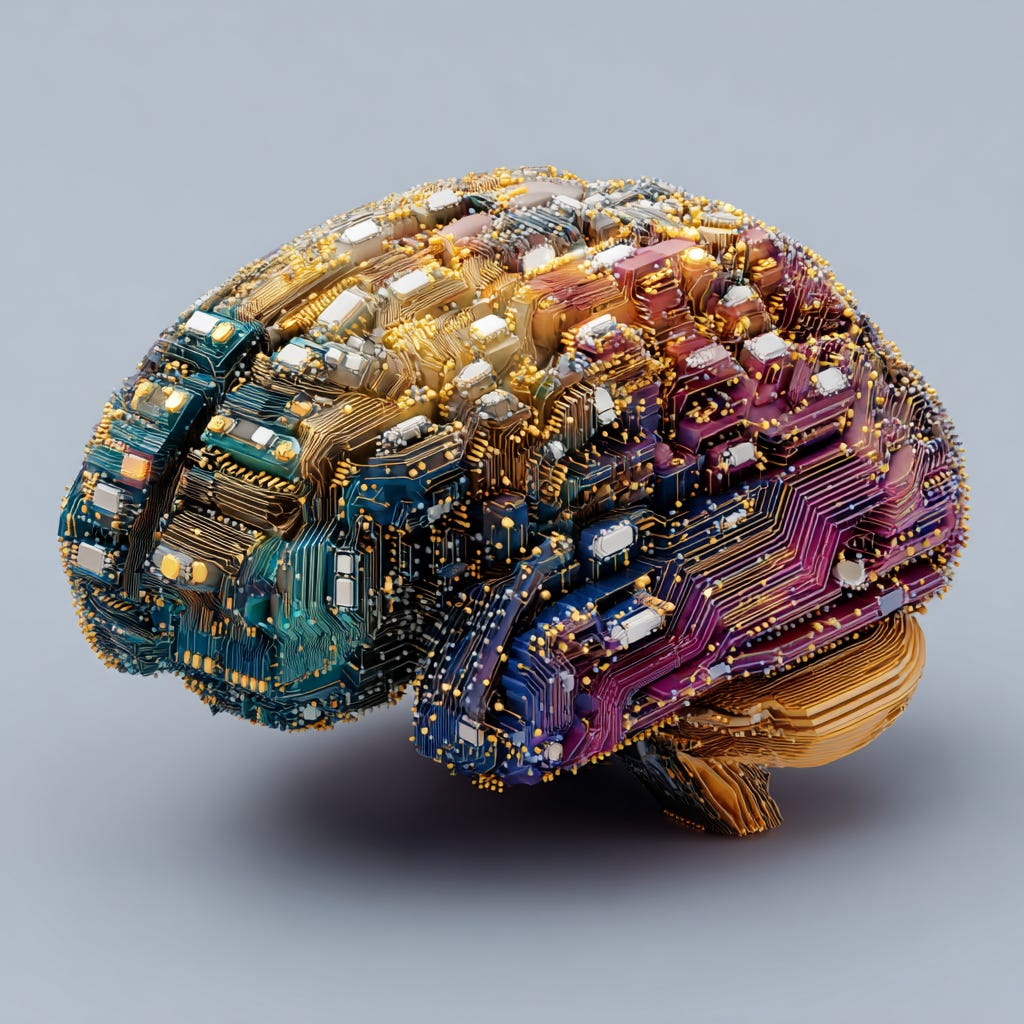
At the heart of that similarity is one simple idea: both our minds and large language models are pattern-learning, pattern-generating systems. You and I did not learn language by memorizing dictionaries or reading formal grammars. We soaked in examples—voices, sentences, stories, interactions—and gradually internalized the patterns. Once those patterns crystallized, we could generate our own sentences, our own styles, our own ways of explaining the world. Large language models do something structurally analogous in text space. They absorb unimaginably many examples of language and, once trained, can produce new strings that follow those same regularities on demand.
This is not just a cute analogy; it is the core mechanism behind both human culture and machine behavior. Civilization itself is a gigantic pattern engine. We copy behaviors, imitate styles, adopt norms, remix ideas. We observe a certain way of arguing, leading, loving, building, or writing—and after enough exposure, we can reproduce that pattern ourselves, sometimes with a twist that becomes the next pattern others copy. Language, institutions, scientific methods, legal frameworks, artistic genres: all of them are accumulated patterns that people learn, internalize, and regurgitate with variation. Large language models sit directly on top of this cultural substrate, because their entire training corpus is the surface trace of this civilizational pattern-learning process.
But similarity in behavior does not automatically imply similarity in kind. A parrot can repeat a phrase; that does not mean it understands the political speech it just mimicked. With large language models, the temptation to anthropomorphize is much stronger, because the patterns they’ve absorbed are so rich and multi-layered that their outputs cross a critical threshold of coherence. When a model can explain your own emotions back to you in fluent, empathic language, you instinctively attribute inner life to it. The fact that it uses many of the same computational tricks as your brain—prediction, hierarchical representations, attention, generalization—only strengthens that intuition.
The purpose of this article is to separate architecture from experience. On the architectural level, we will walk through a set of principles where the human mind and large language models behave in strikingly similar ways: prediction as the core operation, hierarchical representations, statistical learning from examples, distributed concepts, pattern completion, error-driven learning, attention, generalization, over-generalization, emergent feature detectors, compression of regularities, and context-dependent interpretation. For each, we will look at what the mechanism is for, how it shows up in human cognition, how it shows up in an LLM, and where the analogy breaks down.
What emerges from that comparison is a clear picture: large language models replicate a slice of cognition that evolution discovered long ago—how to build a world-model by compressing patterns in experience and using those patterns to predict what comes next. They are, in that sense, “mind-like”. But at the same time, they lack the essential ingredients that give human cognition its depth: embodiment, emotion, long-term goals, social commitments, the ability to suffer, and a direct grip on reality beyond text. They are plugged into our civilization’s outputs (language), not into the world that gave rise to those outputs in the first place.
Understanding this duality matters for at least three reasons. First, it keeps us sane conceptually: we avoid both naive hype (“it’s basically a person”) and naive dismissal (“it’s just autocomplete”). Second, it clarifies what these systems are genuinely good at: leveraging the vast, compressed memory of civilization’s patterns to help us think, write, design, and coordinate. Third, it highlights their blind spots: anywhere truth, responsibility, or empathy require more than just linguistic plausibility, we are in territory where pattern-matching alone is not enough.
In the pages that follow, we will therefore treat large language models not as alien minds, nor as trivial toys, but as synthetic pattern engines that mirror some of the core algorithms our own minds use—while remaining fundamentally different in what they are and what they can be trusted with. By tracing the parallels carefully, we gain a sharper sense of why they work so well. By tracing the differences just as carefully, we protect ourselves from the illusion that “working well” in language is the same as “being wise” or “being alive.”
If we get this framing right, we can use these systems in a way that is both ambitious and grounded. We can let them extend our linguistic and conceptual reach—summarizing, rephrasing, remixing, and amplifying the patterns our civilization has already discovered—without surrendering the uniquely human parts of cognition that they do not possess: judgment, care, responsibility, and the ability to decide what actually matters.
Summary
1. Prediction as the Core Operation
What it is: Using past patterns to guess what comes next.
Human mind – what it does:
Your brain constantly predicts the next sound, word, outcome, reaction. When reality doesn’t match, you get prediction error (surprise, confusion) and your brain updates its internal model.LLM – what it does:
The model is trained to predict the next token in a text sequence. Every parameter in the network exists to make that prediction more accurate.Same principle: Both are prediction machines that learn by reducing prediction error.
Key difference:
The brain predicts the world (multisensory, social, physical). The LLM predicts text only.
2. Hierarchical Representations
What it is: Layers from simple to complex: low-level features → higher-level structure.
Human mind:
Vision: edges → shapes → objects → scenes.
Language: sounds → words → phrases → sentences → narratives → ideas.
Higher levels send expectations back down and reshape perception.LLM:
Lower layers: local token statistics.
Middle layers: syntax and short-range structure.
Higher layers: topic, style, loose semantics.Same principle: Multi-layer representation, where higher layers encode more abstract structure.
Key difference:
Brain’s hierarchy is multimodal and bidirectional. LLM’s hierarchy is text-only and (at inference) feedforward.
3. Statistical Learning from Examples
What it is: Extracting regularities (frequencies, co-occurrences) just by seeing lots of examples.
Human mind:
Learns grammar, social norms, physical regularities from life, without explicit rulebooks. Very data-efficient: a few examples can be enough.LLM:
Learns the patterns of language from huge text corpora. Very data-hungry: needs billions of tokens to discover stable patterns.Same principle: Rules and structures emerge from data; they’re not hand-coded.
Key difference:
Human learning is grounded in real-world experience. LLM learning is grounded only in text distributions.
4. Distributed Representations of Concepts
What it is: A concept is not stored in one place, but as a pattern across many units.
Human mind:
“Dog” = visual features, sound of barking, motor patterns, emotional associations, the word itself – all spread across many neurons.LLM:
“Dog” = a high-dimensional vector and pattern of activations across many artificial neurons; close in space to “cat”, far from “justice”.Same principle: Concepts are encoded as patterns, not discrete symbolic slots. Similar concepts share overlapping patterns.
Key difference:
Human concepts are multimodal and embodied. LLM concepts are purely linguistic and relational.
5. Pattern Completion from Partial Input
What it is: Filling in missing or noisy pieces using learned patterns.
Human mind:
Understands speech in noise, guesses half-finished sentences, infers intent from minimal cues. Uses world knowledge + context + goals.LLM:
Takes a prefix and continues it: story, explanation, code, etc. Fills gaps with the most likely tokens.Same principle: Fragment → activate nearest pattern → complete the pattern.
Key difference:
Humans check completion against meaning and reality and can notice “I might be guessing.” LLMs complete according to token probability, with no awareness of truth.
6. Error-Driven Learning
What it is: Using the mismatch between expected and actual outcome to update the model.
Human mind:
Prediction error influences synaptic plasticity. Dopamine signals reward prediction errors; surprise drives learning.LLM:
Loss function measures error between predicted and correct token; backpropagation adjusts weights to reduce future error.Same principle: Learning happens where predictions fail.
Key difference:
Brain errors are messy, embodied, and emotion-modulated. LLM errors are precise numerical gradients.
7. Attention / Selective Focus
What it is: Giving more processing to some inputs and less to others.
Human mind:
Attention is steered by goals, emotion, novelty, threat. It’s limited and fluctuates; what you attend to shapes what you learn.LLM (transformer):
Self-attention weights tokens differently based on query–key similarity. Multi-head attention can focus on different relationships in parallel.Same principle: Selective emphasis on relevant signals, suppression of noise.
Key difference:
Human attention is motivated and resource-limited. LLM attention is purely algorithmic and not tied to any goals or feelings.
8. Generalization Beyond Memorization
What it is: Applying learned patterns to new, unseen cases.
Human mind:
Produces new sentences, solves new problems, transfers patterns across domains using analogy and abstract reasoning.LLM:
Generates sentences that never appeared in training but follow grammar, style, and association patterns.Same principle: Internalized patterns function as rules that can be applied to novel inputs.
Key difference:
Humans generalize in form and meaning (with causal and social understanding). LLMs generalize primarily in form and statistical association.
9. Over-Generalization
What it is: Applying a useful pattern too broadly, where it no longer fits.
Human mind:
Kids say “goed”, adults form stereotypes, or oversimplify complex realities with one story.LLM:
Hallucinates plausible-sounding but false facts; overuses common phrases; smooths over rare exceptions.Same principle: Strong patterns tend to override exceptions.
Key difference:
Humans can reflect (“I’m over-generalizing”) and revise beliefs. LLMs only change when training/fine-tuning explicitly penalizes those outputs.
10. Emergent Feature Detectors
What it is: Units that become specialized in detecting specific patterns, without being manually defined.
Human mind:
Neurons/areas tuned to edges, faces, voices, words, emotions – shaped by both evolution and experience.LLM:
Some attention heads track subject–verb agreement, others quotation marks, list structure, coreference, sentiment, etc.Same principle: Specialization emerges when a system learns from rich data; different units become “experts” in different sub-patterns.
Key difference:
Brain detectors are multimodal, plastic, and can be repurposed. LLM detectors are linguistic, fixed after training, and live in a clean digital space.
11. Compression of Regularities
What it is: Turning a huge stream of data into compact internal models that capture what usually happens.
Human mind:
Compresses life into schemas (“how meetings work”), mental models, narratives, and intuitions. Keeps gists, prototypes, emotionally important episodes.LLM:
Compresses vast corpora into a finite set of weights that encode language regularities. Loses most verbatim detail, keeps what helps prediction.Same principle: Store structure, not raw data; expand it back out on demand (memory or generated text).
Key difference:
Human compression is driven by meaning, goals, emotion. LLM compression is driven solely by loss minimization on text.
12. Context-Dependent Interpretation
What it is: The same signal has different meaning depending on context.
Human mind:
Interprets words, gestures, tone, and actions using linguistic, physical, social, and personal context – including history with the other person and current mood.LLM:
Interprets tokens based on the rest of the prompt and its pre-trained weights; resolves ambiguity by looking at co-occurrence patterns.Same principle: Context selects which internal pattern is activated, and thus what meaning/output emerges.
Key difference:
Human context = entire lived world + memory + identity. LLM context = current text window + frozen training distribution.
The Similiarities and Differences
1. Prediction as the Core Operation
What this feature is and what it’s for
Prediction means using what you already know to guess what will happen next (the next sound, word, event, or outcome).
Its purpose is efficiency and survival: if you can anticipate what comes next, you can react faster, use less energy, and catch mistakes sooner.
Similarity: how humans and LLMs both use prediction
Both the human mind and large language models are essentially next-step guessers.
Your brain constantly predicts the next word someone will say, the next visual frame you’ll see, or the likely outcome of an action.
An LLM does almost the same thing in a narrower domain: it predicts the next token in a sequence of text.
In both cases, the internal model gets better by comparing what was predicted with what actually happened and then adjusting the internal parameters.
Key comparison dimensions
What is being predicted
How predictions are learned
How error is used
Time scale and scope
What is being predicted
Human mind:
Predicts across modalities and levels: next sound, word, movement, emotional reaction, social response, reward or pain, etc.
Prediction is about the world.LLM:
Predicts only the next token (word/subword) in a text sequence.
Prediction is about text, not the world directly.
How predictions are learned
Human mind:
Learns from lived experience: sensory input, actions, feedback, social interaction.
A few exposures can be enough to update predictions strongly.LLM:
Learns from static datasets by repeatedly predicting tokens and adjusting weights.
Needs enormous amounts of text and many passes to converge.
How error is used
Human mind:
Prediction error shows up as surprise, confusion, or conflict; it drives attention and plasticity (you notice, you remember, you update).
Error signals are messy, distributed, and gated by neuromodulators (e.g. dopamine).LLM:
Prediction error is a number in a loss function.
Backpropagation uses it to deterministically nudge millions/billions of parameters.
Time scale and scope
Human mind:
Predicts at many time scales: milliseconds (sounds), seconds (sentences), hours/days (plans), years (life strategies).
Predictions are embedded in goals and values.LLM:
Predicts locally, token by token, within its context window.
Any “long-term” structure is emergent from many local predictions, not a conscious plan.
2. Hierarchical Representations
What this feature is and what it’s for
Hierarchical representation means building layers of structure: simple features at the bottom, complex concepts at the top.
Its purpose is compression and abstraction: reuse lower-level patterns (sounds, strokes, words) to build higher-level ones (phrases, ideas, stories) efficiently.
Similarity: how humans and LLMs both use hierarchies
Both brains and LLMs turn raw sequences into multi-layered internal structures.
In humans, sounds → syllables → words → phrases → meanings → narratives.
In transformers, early layers model local token statistics, later layers model sentence-level and discourse-level patterns.
In both systems, higher levels “know” about more abstract structure, and lower levels deal with detail.
Key comparison dimensions
Levels of representation
How hierarchy is built
Flexibility and “top-down” influence
Integration across modalities
Levels of representation
Human mind:
Sensory cortex: edges/tones → features → objects → scenes.
Language areas: phonemes → morphemes → words → syntax → semantics → discourse.
Each higher level captures more meaning and context.LLM:
Lower layers: local token patterns (spelling, short-range collocations).
Mid layers: syntax, phrase structures.
Higher layers: topic, style, loosely “semantic” relations.
Each higher layer captures more statistical context, but not grounded meaning.
How hierarchy is built
Human mind:
Built developmentally: infants first learn raw perceptual features, then words, then abstract ideas.
Structure shaped by evolution + development + experience.LLM:
Built by training all layers end-to-end with backprop.
We don’t explicitly tell a layer “you are syntax”; it emerges as the easiest way to reduce prediction error.
Flexibility and “top-down” influence
Human mind:
Strong top-down effects: beliefs, expectations, and goals modulate perception (what you expect to see/hear changes what you actually perceive).
You can reinterpret the same input differently based on a new high-level belief.LLM:
“Top-down” effects are indirect: later layers influence earlier ones only during training, not during a single forward pass.
At inference, there’s no real feedback – hierarchy is mostly feedforward.
Integration across modalities
Human mind:
Higher levels integrate vision, sound, touch, interoception, social context, emotion.
Concepts are inherently multimodal and embodied.LLM:
Standard LLMs are text-only; hierarchy exists purely in linguistic space.
Multimodal models exist, but for a pure LLM, “apple” is never taste/smell; it’s just relations between tokens.
3. Learning from Many Examples (Statistical Learning)
What this feature is and what it’s for
Statistical learning means extracting regularities (frequencies, co-occurrences, patterns) from repeated exposure to examples.
Its purpose is to infer rules without being told: to discover grammar, norms, and structure directly from data instead of explicit instruction.
Similarity: how humans and LLMs both learn statistically
Both humans and LLMs become capable by soaking in huge numbers of examples and extracting what tends to go with what.
A child hears thousands of sentences and intuits grammar; an LLM “reads” billions of tokens and internalizes linguistic regularities.
Neither needs hard-coded rules; rules emerge from statistics.
Key comparison dimensions
Source of examples
Data efficiency
Type of regularities learned
Handling of exceptions and biases
Source of examples
Human mind:
Gets examples through life: real-time sensory experience, social interaction, feedback, emotions.
Data is noisy but deeply structured and grounded.LLM:
Gets examples from corpora: books, websites, code, transcripts, etc.
Data is vast but purely symbolic (text) and filtered by what humans chose to write/publish.
Data efficiency
Human mind:
Highly data-efficient: can infer a pattern from a handful or even a single striking example (one-shot / few-shot learning).
Strong inductive biases (built-in priors) help generalize quickly.LLM:
Data-hungry: needs massive amounts of examples.
Inductive bias is weak and generic (“whatever reduces loss”), so it compensates with scale.
Type of regularities learned
Human mind:
Learns not just surface statistics, but also causal and social patterns: why things happen, how people react, what is safe or dangerous.
Can infer unobserved structure (“they’re upset because…”).LLM:
Learns primarily surface co-occurrence and sequence patterns.
Any apparent causal understanding is a side-effect of text patterns, not grounded causal models.
Handling of exceptions and biases
Human mind:
Overgeneralizes early (“goed”), but gets corrected by grounded feedback and social interaction.
Can “override” patterns when a single counterexample is highly salient or emotionally loaded.LLM:
Overgeneralizes whatever is statistically dominant in training (including social biases, stereotypes).
Needs explicit fine-tuning or curation to correct for harmful or misleading patterns.
4. Distributed Representation of Concepts
What this feature is and what it’s for
Distributed representation means that a concept (like “dog” or “justice”) is not stored in one place, but as a pattern spread across many units (neurons or artificial neurons).
Its purpose is robust, flexible, and similarity-aware coding:
Robust: no single unit’s failure destroys the concept.
Flexible: concepts can overlap and combine.
Similarity-aware: similar concepts share overlapping patterns.
Similarity: how humans and LLMs both use distributed codes
Both the human brain and LLMs avoid “one symbol = one cell” storage.
Instead, they encode concepts as activation patterns across large populations of units.
“Dog” and “cat” share many active units (because they’re similar), while “dog” and “democracy” overlap much less.
This makes both systems good at fuzzy similarity (“this feels close to X”) and smooth generalization (“this looks like a dog even from a weird angle / in a weird sentence”).
Key comparison dimensions
Where and how the pattern lives
What makes two patterns “similar”
Robustness and damage tolerance
How combinations and new concepts are formed
Where and how the pattern lives
Human mind:
A concept is a pattern of firing across many neurons in multiple regions (sensory, language, memory, emotional areas).
“Apple” involves visual shape, color, taste, motor programs (grasping), word sound, emotional associations.
The pattern is multi-area and multimodal: no single neuron “is” an apple, but many neurons “participate” when you think of one.
LLM:
A concept is a vector in a high-dimensional embedding space plus the way it’s transformed by layers.
“Apple” and “pear” are nearby points in that space because they appear in similar text contexts.
The pattern is mathematical and text-only: a concept is just a point and its trajectory through the network, not tied to any sensory modality.
What makes two patterns “similar”
Human mind:
Similarity arises from shared experience: you’ve seen dogs and wolves in similar situations, so their neural patterns overlap.
Similarity is grounded: dog and cat feel similar partly because they look, move, and behave similarly in the real world.
LLM:
Similarity arises from shared linguistic context: words that co-occur in similar sentences end up with similar vectors.
Dog and cat are similar because texts talk about them in similar ways (pets, fur, food, etc.), not because the model has ever “seen” them.
Robustness and damage tolerance
Human mind:
Because concepts are distributed, losing some neurons (aging, minor injury) usually doesn’t erase them completely.
Memory can degrade gracefully: you might lose detail but keep the gist.
This contributes to resilience: the system can tolerate noise and partial information.
LLM:
Because representations are spread over many parameters, small weight perturbations don’t usually destroy a concept either.
You can prune some neurons/weights and the model often still works (with small quality loss).
However, retraining or fine-tuning can accidentally distort patterns (catastrophic forgetting) if not done carefully.
How combinations and new concepts are formed
Human mind:
You can blend patterns: imagine a “flying car,” “green sun,” or “empathetic AI” by mixing elements of existing concepts.
This relies on distributed codes being composable – overlapping neural patterns can form new stable configurations.
Emotional and bodily context also shape how combinations feel (a “friendly dragon” vs. a “terrifying dragon” recruits different emotional circuits).
LLM:
New combinations are formed by vector arithmetic and pattern recombination: the model can describe “a dragon made of glass” without having seen it in training, by recombining patterns for “dragon” and “glass”.
This compositionality is purely linguistic: it stitches together words and properties that it has seen co-occur or that fit grammatically.
There is no felt sense of novelty; it’s just applying learned composition patterns (e.g. adjectives modifying nouns).
5. Pattern Completion from Partial Input
What this feature is and what it’s for
Pattern completion means taking incomplete, noisy, or ambiguous input and filling in the missing pieces using what you’ve already learned.
Its purpose is robust perception and continuity:
To make sense of incomplete signals (noisy speech, blurry vision, half-finished sentences).
To maintain a stable reality when data is imperfect or interrupted.
Similarity: how humans and LLMs both do pattern completion
Both the human mind and LLMs are auto-completers.
You hear half a sentence and already “know” how it will likely end.
An LLM sees a few words and can continue them into a coherent paragraph.
In both cases, the system uses stored patterns to guess what fits best into the gap.
The key shared idea: the current fragment activates an internal pattern that naturally wants to “snap” into a complete shape.
Key comparison dimensions
Types of partial input
What drives the completion
Strengths and failure modes
Awareness and self-correction
Types of partial input
Human mind:
Degraded sensory input:
Noisy audio: you still understand speech in a loud bar.
Low visibility: you recognize a friend in the dark.
Incomplete linguistic input:
Half-finished sentences: “If you could just…” → you infer the request.
Typos and broken grammar: your brain silently “fixes” them.
Social/behavioral patterns:
Sparse cues (tone of voice, small gesture) → you infer the emotional state or intention.
LLM:
Truncated text prompts:
“Once upon a” → continues to “time…” plus full story.
Incomplete questions or instructions:
“Explain why cats…” → it infers likely continuations (purr, land on feet, etc.) and picks one based on context.
Noisy or ungrammatical input:
It often “normalizes” and answers as if the intent were clearly stated.
What drives the completion
Human mind:
Driven by experience-based expectations:
Lifelong exposure to language, social interactions, and world regularities.
Uses multimodal context:
Body language, environment, emotional state, past episodes all influence what you “fill in.”
Heavily shaped by meaning and goals:
You complete in a way that makes semantic and pragmatic sense (what would this person actually say/do?).
LLM:
Driven by statistical patterns in text:
It asks internally: “Given this prefix, which token historically tends to come next?”
Uses only the textual context window plus its learned weights.
Completion is guided by probability, not meaning:
It picks what is most likely linguistically, even if it’s factually wrong or pragmatically silly.
Strengths and failure modes
Human mind – strengths:
Very good at disambiguating using world knowledge:
“I put the glass on the bank” → river vs money? You use the whole situation to choose.
Can reject completions that violate common sense (“The elephant sat on the matchbox and it broke the elephant”).
Can notice when completion is uncertain and ask for clarification (“Wait, did you mean X or Y?”).
Human mind – failure modes:
Illusions and biases:
Visual illusions: the brain over-completes patterns and “sees” lines or shapes that aren’t there.
Cognitive biases: we fill gaps with stories that match our beliefs, not the data.
LLM – strengths:
Extremely good at formal pattern completion:
Code, rhyme schemes, legal boilerplate, email templates.
Can maintain local consistency over long text spans if patterns are clear (e.g. keep a narrative voice or technical style).
LLM – failure modes:
Hallucinations:
It completes patterns into plausible but false facts, citations, or biographies.
Over-committing to a wrong assumption:
If the prompt is ambiguous, it confidently chooses one completion instead of asking.
No internal “alarm” for nonsense:
It may happily continue an absurd premise logically, because logic is just another pattern.
Awareness and self-correction
Human mind:
Has meta-awareness:
You can notice “I might be guessing here” or “this feels like a projection.”
Can voluntarily override automatic completion:
Slow down, ask questions, re-interpret the input.
Social context can trigger re-checking:
If the other person looks confused, you revise your assumption about what they meant.
LLM:
No built-in awareness:
It doesn’t know it is completing a pattern; it just outputs tokens.
“Self-correction” happens only if explicitly prompted:
(“Check your previous answer”, “List possible interpretations…”) – and even then, it’s applying yet another textual pattern.
No intrinsic uncertainty signal:
It doesn’t feel “I might be wrong”; any hedging like “I’m not sure” is just another pattern it learned to use.
6. Error-Driven Learning
What this feature is and what it’s for
Error-driven learning means: use the gap between what you expected and what actually happened to update your internal model.
Its purpose is continuous improvement: without errors, you have no signal for how to change.
Similarity: how humans and LLMs both learn from error
Both the human mind and LLMs get better by making mistakes and adjusting.
Humans predict the world, notice mismatches (surprise, confusion, failure), and their brains adapt.
LLMs predict the next token, compare it to the true next token, and adjust weights via backprop.
In both cases, no error = no learning; the system only updates where predictions fail.
Key comparison dimensions
How error is computed
How updates are applied
Where feedback comes from
Timescale and continuity
How error is computed
Human mind:
Error is implicit: conflict between expectation and reality → “prediction error”.
Shows up as surprise, discomfort, confusion, or reward-prediction error (dopamine spike/dip).
It’s noisy, approximate, and often subconscious.
LLM:
Error is explicit: loss function (e.g. cross-entropy) between predicted token distribution and true token.
A single numeric gradient for each parameter tells how wrong it was.
It’s precise, algorithmic, and fully observable.
How updates are applied
Human mind:
Uses local plasticity: synapses change where activity and error signals co-occur.
Many parallel, slow, small adjustments spread through the network.
Updates are modulated by context (emotion, attention, sleep).
LLM:
Uses backpropagation + gradient descent: a global algorithm updates all layers in one step.
Millions/billions of weights nudge in exactly the mathematically optimal direction (for that minibatch).
No sleep, no hormones, just math.
Where feedback comes from
Human mind:
From the world: physical consequences, social reactions, internal emotions.
You learn not just from “wrong answers”, but from pain, embarrassment, joy, approval, etc.
Feedback signal is rich and multi-dimensional.
LLM:
From the training data: the correct token sequence is the only teacher.
Optionally extended by curated human feedback in fine-tuning (thumbs up/down, preference data).
Feedback is narrow: “this token should have been X”.
Timescale and continuity
Human mind:
Learns continuously: every experience can, in principle, alter the model.
Learning is spread over seconds to years; deep conceptual shifts can take a long time.
LLM:
Learns in offline training phases; once deployed, weights are usually fixed.
Interaction errors don’t automatically update the model; retraining/fine-tuning is needed.
7. Attention / Selective Focus
What this feature is and what it’s for
Attention means selectively giving more processing resources to some inputs and less to others.
Its purpose is efficiency and relevance: there’s too much information, so you must focus on what matters and ignore the rest.
Similarity: how humans and LLMs both use attention
Both humans and transformers solve the “too much information” problem by weighting some inputs more heavily.
Humans shift mental spotlight: you listen to one voice in a noisy room, watch one player in a game.
LLMs use self-attention to weight important tokens and diminish irrelevant ones when computing each next representation.
In both, attention defines which patterns get to influence the outcome.
Key comparison dimensions
What controls attention
Granularity (how selective it can be)
Limits and capacity
Role in learning vs inference
What controls attention
Human mind:
Controlled by goals, emotion, novelty, threat, and habits.
Top-down: “I decide to focus on this task.”
Bottom-up: loud noise, bright light, or emotional cue steals focus automatically.
LLM:
Controlled by the learned weights and the current tokens.
No goals or emotions; attention weights are computed mechanically from query/key vectors.
“Salience” is purely statistical, not affective.
Granularity
Human mind:
Can focus on:
A specific sensory feature (red object in scene).
A high-level idea (“what’s her real intention?”).
Shifts can be coarse (switching tasks) or fine (noticing a micro-expression).
LLM:
Attention operates over tokens (or positions) in the sequence.
Multi-head attention lets it focus on multiple pattern types simultaneously (syntax, coreference, etc.).
Granularity is fixed by architecture (tokenization + number of heads).
Limits and capacity
Human mind:
Strong capacity limits (you can’t deeply attend to many things at once).
Attention fluctuates with fatigue, stress, interest.
LLM:
Main limit is context window length and compute – it can “attend” across thousands of tokens in parallel.
No fatigue; attention quality is constant given the same input and parameters.
Role in learning vs inference
Human mind:
Attention shapes what you learn: what you attend to gets encoded more strongly.
Also shapes inference: you interpret a situation differently depending on what you notice.
LLM:
During training, attention structure is learned (weights are updated).
During inference, attention just routes information; it doesn’t change the weights.
It affects how patterns are combined, but not which patterns are stored.
8. Generalization Beyond Memorized Cases
What this feature is and what it’s for
Generalization means applying learned patterns to new, unseen situations instead of only reproducing memorized examples.
Its purpose is flexibility and creativity: you can handle infinite novel cases from finite data.
Similarity: how humans and LLMs both generalize
Both humans and LLMs can produce outputs they’ve never seen before but that still follow the learned rules.
A human can invent a brand-new sentence or idea that respects grammar and logic.
An LLM can generate entirely new text in a style it has only seen examples of.
In both, internalized patterns act like rules that can be applied to new inputs.
Key comparison dimensions
What is generalized (form vs meaning)
Data needed for reliable generalization
Types of novelty they handle well
Failure modes at the edge of distribution
What is generalized
Human mind:
Generalizes both form and meaning:
Form: grammar, narrative structure.
Meaning: causal rules, social norms, physical intuitions.
Can carry concepts across domains (“this business problem is like chess/endgame”).
LLM:
Generalizes mainly form and statistical associations in language.
Apparent “conceptual” generalization is downstream of patterns in text, not direct causal models.
Cross-domain analogies are pattern-based: if texts compare A to B, it can mimic that pattern.
Data needed for reliable generalization
Human mind:
Few examples often enough, thanks to strong priors and rich context.
Can generalize from one vivid example if it fits existing conceptual structure.
LLM:
Needs many varied examples to generalize reliably and robustly.
Sparse patterns in training are brittle; model tends to fail outside well-represented regimes.
Types of novelty handled well
Human mind:
Very good at structural novelty:
New problems that share deep structure with known ones.
Uses analogy, abstraction, and explicit reasoning to bridge gaps.
LLM:
Very good at combinatorial novelty in language:
New combinations of known styles, topics, and phrasings.
Handles “ remix ” tasks (X in the style of Y) surprisingly well.
Failure modes at the edge of distribution
Human mind:
Can misgeneralize based on bias or limited experience (stereotypes, naive intuitions).
But can notice the mismatch and revise (“I thought it would work, but clearly it doesn’t”).
LLM:
Hallucinates most outside its training distribution; still produces fluent text but with incorrect facts or logic.
Has no internal alarm that says “I’m out of my depth here” unless such hedging is part of its learned pattern.
9. Over-Generalization from Patterns
What this feature is and what it’s for
Over-generalization means applying a learned pattern too broadly, beyond the cases where it actually holds.
Its purpose is a side-effect of a useful principle:
If you generalize, you become powerful and efficient.
If you generalize too much, you make systematic mistakes.
So over-generalization is the cost of having a pattern engine instead of a lookup table.
Similarity: how humans and LLMs both over-generalize
Both the human mind and LLMs go wrong in the same structural way:
They learn a pattern that works often and then apply it where it doesn’t fit.
Children say “I goed” because they internalized “add -ed for past tense”.
LLMs hallucinate plausible-but-false “facts” because they internalized “when people talk about X, Y often follows”.
In both cases, the system prefers a smooth pattern over messy exceptions unless there’s strong correction.
Key comparison dimensions
Typical forms of over-generalization
Correction mechanisms
Role of exceptions and outliers
Where this becomes dangerous
Typical forms of over-generalization
Human mind:
Language:
“Goed”, “runned”, “mouses” – kids apply a productive rule to irregulars.
Concepts & stereotypes:
“All dogs are dangerous” after one bad experience.
Social stereotypes: over-extending small-sample patterns to whole groups.
Heuristics:
“This strategy worked once, so it will always work.”
LLM:
Linguistic templates:
Overuse of certain stock phrases or structures because they’re common in training (“As an AI language model…”).
Factual hallucinations:
“If a scientist has X profile, they probably won a famous prize” → invents awards, dates, citations.
Style patterns:
Over-applies a tone or rhetorical trope (e.g., motivational clichés) because they frequently co-occur with certain topics.
Correction mechanisms
Human mind:
Direct feedback:
Adults correct language (“it’s ‘went’, not ‘goed’”), peers react, reality pushes back.
Experience expansion:
More varied examples show the limits of a rule (“not all dogs bite”).
Reflective thinking:
You can consciously notice: “I’m generalizing too much; I only saw this twice.”
LLM:
Dataset curation & fine-tuning:
Developers filter training data and add corrective examples or negative examples.
Reinforcement learning from human feedback (RLHF):
Human raters penalize unhelpful or false outputs; the model gets steered away from those patterns.
Prompting constraints:
Users explicitly ask for caveats, citations, or multiple possibilities to suppress over-confident over-generalization.
Role of exceptions and outliers
Human mind:
Exceptions can be highly salient and change behavior quickly.
One shocking event (accident, betrayal) can override a prior generalized belief.
We can store exceptions as “special cases” alongside the general rule.
LLM:
Exceptions are just more data points in a huge corpus.
If exceptions are rare, they get averaged away in the statistical pattern.
Without explicit emphasis in training, the model tends to smooth them out.
Where this becomes dangerous
Human mind:
In social and moral domains: prejudice, superstition, persistent myths.
Over-generalization can lock in toxic beliefs that resist correction.
LLM:
In high-stakes use: it can confidently output wrong medical, legal, or safety-critical info because it “fits the pattern”.
Illusion of competence: fluent text makes over-generalization hard to detect for non-experts.
10. Emergent Feature Detectors
What this feature is and what it’s for
Emergent feature detectors are units (neurons / artificial neurons or heads) that become specialized in recognizing certain patterns – not because we hand-designed them, but because learning shaped them that way.
Their purpose is efficient specialization:
Different parts of the system become experts in different sub-patterns (edges, faces, syntactic roles, sentiment, etc.).
Together, they form a rich toolkit for understanding complex input.
Similarity: how humans and LLMs both develop specialized pattern detectors
Neither the brain nor LLMs start with a fully hand-crafted set of “detector modules”.
Instead, as they train on experience/data, some units evolve into detectors for recurring patterns.
In brains: some neurons respond strongly to faces, specific objects, or particular phonemes.
In LLMs: some attention heads focus on subjects, others on verb arguments, some on quotation boundaries, etc.
This emergence is a shared signature of powerful pattern-learning systems.
Key comparison dimensions
How specialization emerges
What gets detected
Transparency and interpretability
Flexibility and re-use
How specialization emerges
Human mind:
Early in development, neurons are somewhat general-purpose but become tuned through exposure.
Repeated activation by specific features (e.g., faces, certain sounds) strengthens those connections – classic Hebbian tuning.
Evolution pre-biases some areas (e.g., fusiform face area) to easily become certain types of detectors, but exact tuning is experience-dependent.
LLM:
Randomly initialized networks gain structure through gradient descent.
During training, some units consistently reduce loss by responding to specific patterns (e.g., matching brackets, pronouns, tense).
No explicit instruction says “this head is for coreference”; it’s simply the function that the optimization finds.
What gets detected
Human mind:
Low-level: edges, orientations, simple tones, motion directions.
Mid-level: faces, hands, particular objects, familiar voices.
High-level: words, idioms, emotional tones, intentions, “this is a joke”, “this is a threat”.
LLM:
Low-level: token boundaries, frequent character patterns, basic n-grams.
Mid-level: syntactic roles, phrase boundaries, named entities.
High-level: discourse structure, formality, sentiment, whether a sentence is part of a list or an explanation.
Transparency and interpretability
Human mind:
We can sometimes empirically find highly specialized neurons (e.g., strong responses to a specific person’s face), but most representations are very distributed.
Subjective experience tells us something about what’s being detected, but not the exact implementation.
LLM:
We can probe attention heads and neurons and sometimes identify clear roles (“this head tracks subject-verb agreement”).
But overall, representations are also entangled and distributed – most units don’t map cleanly to a single human-readable feature.
Interpretability tools can reveal glimpses, but the internal specialization is opaque at scale.
Flexibility and re-use
Human mind:
Detectors remain plastic: tuning can change with new experience or damage; areas can be repurposed (e.g., visual cortex used for Braille in blind individuals).
A detector can participate in many patterns (e.g., a face neuron also used in emotional recognition tasks).
LLM:
Once trained, detectors are basically frozen unless you fine-tune the model.
However, each unit participates in many computations across tasks; the same head can be useful in translation, summarization, Q&A.
Limited true repurposing without retraining, but broad reuse within what’s already encoded.
11. Compression of Regularities
What this feature is and what it’s for
Compression of regularities means taking a huge number of raw experiences/examples and encoding them into much smaller internal summaries (schemas, rules, weights) that capture what usually happens.
Its purpose is efficiency and generalization:
Efficiency: you don’t need to store every instance in full detail.
Generalization: by storing the common structure, you can apply it to new situations.
Similarity: how humans and LLMs both compress patterns
Both the human mind and LLMs act as compression machines for the structure of their inputs.
Humans compress life into concepts, stories, mental models: millions of events become a handful of principles and intuitions.
LLMs compress terabytes of text into a finite set of numerical parameters (weights) that still let them regenerate typical patterns.
In both systems, regularities survive in compressed form, while exact detail is mostly discarded unless it’s repeatedly important.
Key comparison dimensions
What gets compressed
How compression happens
What is kept vs. what is lost
Consequences for behavior and knowledge
What gets compressed
Human mind:
Experiences → schemas (“how meetings usually go”, “what a friendship is like”).
Language → grammar intuitions, preferred phrasing, “voice”.
World structure → causal models (“if I do X, Y tends to follow”), social roles, norms.
LLM:
Text corpora → weights encoding word co-occurrence, syntactic patterns, discourse structures.
Many documents collapse into a shared representation of how humans talk about X, not separate per-document memory.
How compression happens
Human mind:
Largely unsupervised and incremental: repeated exposure gradually shapes synapses and networks.
Strong events, emotions, and goals drive which patterns get compressed most.
Sleep, replay, and consolidation further “distill” experience into more compact representations.
LLM:
Supervised/self-supervised optimization: gradient descent finds weight settings that minimize prediction loss across huge data.
No explicit “compression step” – compression is an emergent consequence of limited parameter count and optimization pressure.
What is kept vs lost
Human mind:
Keeps:
Gists, prototypes, typical sequences, emotionally salient episodes.
Loses:
Precise detail of most events (exact wording of a conversation, exact visual snapshots).
But can store a few episodes almost “verbatim” if they are extremely important or repeated.
LLM:
Keeps:
Statistically useful regularities that reduce loss: syntactic rules, typical phrasing, associations.
Loses:
Most verbatim text (except frequent formulaic fragments), rare idiosyncratic phrases.
Has no notion of “emotional importance” – only statistical importance.
Consequences for behavior and knowledge
Human mind:
Fast, intuitive decisions: compressed models let you react without re-analyzing raw data.
Stereotypes and heuristics: compression can oversimplify complex realities.
Storytelling: you automatically condense events into narratives and morals.
LLM:
Fast, fluent text generation: it can “expand” compressed weights into long coherent outputs.
Hallucinations: compressed knowledge may blur boundaries between truth and plausible fiction.
Style mimicry: compressed stylistic patterns let it adopt many voices from limited parameter capacity.
12. Context-Dependent Interpretation
What this feature is and what it’s for
Context-dependent interpretation means that the meaning or function of the same input (a word, gesture, action) depends heavily on the surrounding situation.
Its purpose is precision and adaptability:
The world is ambiguous; context is how you disambiguate.
This lets one symbol or behavior carry many meanings in different situations without confusion.
Similarity: how humans and LLMs both depend on context
Both the human mind and LLMs read the same input differently depending on context.
Humans interpret “bank”, “fine”, or a raised eyebrow using surrounding words, tone, prior knowledge, and social scene.
LLMs interpret tokens using the rest of the prompt and adjust which sense, style, or continuation is most probable.
In both, context steers which pattern gets activated and therefore which output you see.
Key comparison dimensions
Sources of context
How ambiguity is resolved
Context range and memory
Limits and failure modes
Sources of context
Human mind:
Linguistic: previous words, conversation history.
Situational: physical environment, who is present, time, place.
Social: relationship with the speaker, norms, power dynamics.
Internal: mood, goals, current concerns, prior beliefs.
LLM:
Only what is inside the text context window + its stored weights.
No direct access to physical, social, or emotional context unless explicitly described in the text.
No internal mood or goals; all “context” is symbolic.
How ambiguity is resolved
Human mind:
Uses semantic, world knowledge, and pragmatic reasoning:
“He sat on the bank and watched the water” → river-bank, not financial institution.
Infers unspoken intentions: sarcasm, politeness, threats.
Can actively ask for clarification if ambiguity remains.
LLM:
Uses statistical co-occurrence:
Looks at neighboring tokens to choose the most probable sense learned from text.
Can mimic sarcasm or politeness patterns, but doesn’t experience intent.
Rarely asks for clarification unless it has seen that pattern used in similar ambiguous prompts.
Context range and memory
Human mind:
Can track context over long conversations, days, even years, via episodic and semantic memory.
Context includes life history with the other person, not just the last few sentences.
Can re-interpret past events in light of new context (“oh, that’s what she meant months ago”).
LLM:
Context is limited to the current prompt window (e.g. a few thousand tokens).
No true long-term memory across sessions unless engineered via external tools.
Cannot spontaneously re-interpret earlier conversations unless that text is re-supplied.
Limits and failure modes
Human mind:
Can misread context due to bias, stress, or incomplete information.
But can reflect and revise (“I misunderstood you earlier”).
Has a sense of when context is insufficient and may explicitly say “I don’t know what you mean.”
LLM:
May choose an inappropriate sense or style when context is thin or unusual.
Tends to fake certainty: will pick one interpretation and continue confidently.
Has no inner signal that “context is missing”, unless that pattern is explicitly part of training.