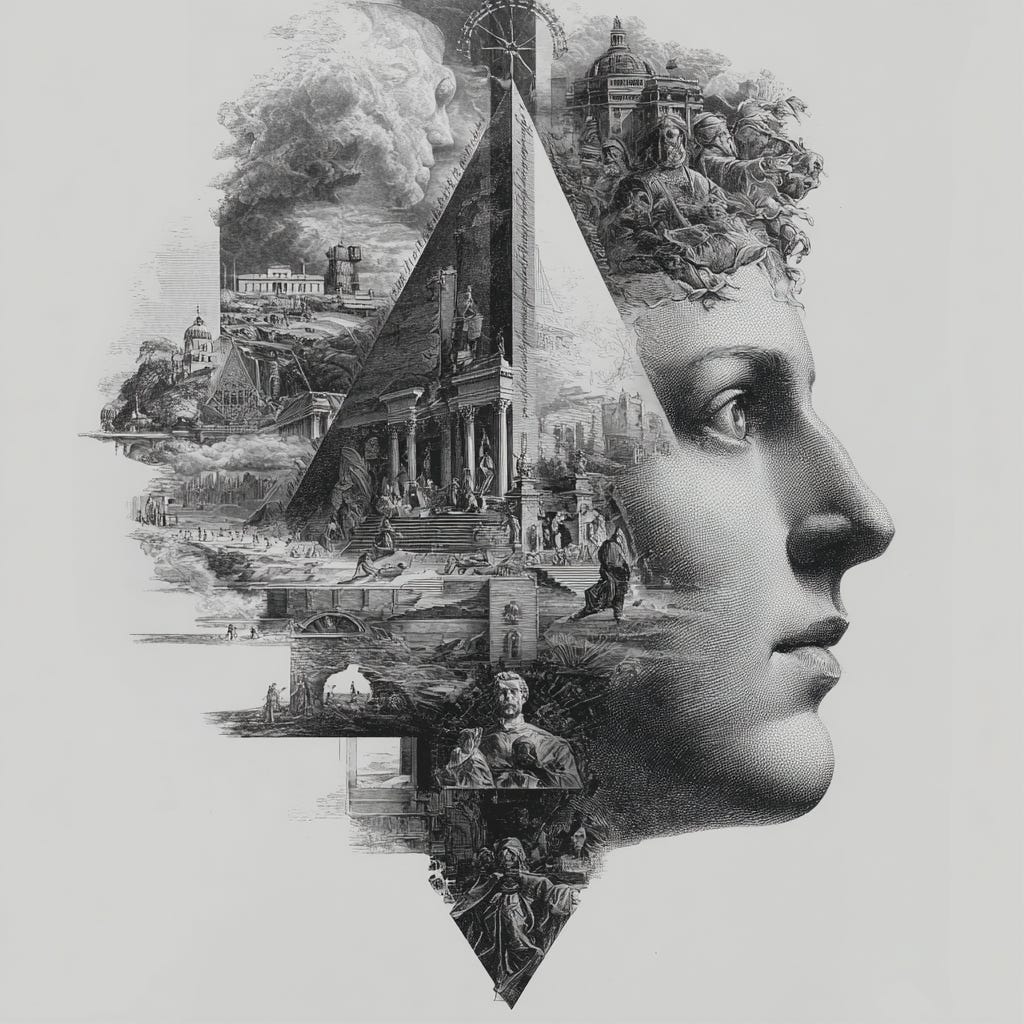
We are entering an age where the distance between a thought and its execution is collapsing. Large language models and agents can finish our sentences, complete our reasoning, generate alternatives, test assumptions, produce artifacts, and carry ideas into action. That is a historic expansion of human capability—but capability alone does not guarantee progress. When output becomes easy, discernment becomes scarce. When persuasion becomes cheap, truth becomes fragile. When acceleration becomes universal, the future belongs to those who can steer it.
The Civilization Builders Manifesto is a response to that moment. It argues that the agentic era is not primarily a tooling revolution, but an educational and civilizational one: we must learn to govern amplified cognition with cultural grounding, moral clarity, and democratic maturity. The point is not to worship speed or produce endless content. The point is to create citizens who can use agentic power to build a better world—deliberately, responsibly, and with a deep awareness of what civilization has already learned through centuries of success and failure.
The manifesto is organized in three parts:
Part I — The New Power explains what agents actually change in practice: how they complete thought, externalize cognition, compress learning, and step into execution—shifting human limitation from “can I do it?” to “what should be done, and why?”
Part II — The Anchors defines the foundations that must steer this power: civilizational memory, cultural inheritance, value literacy, epistemic discipline, systems thinking, and democratic maturity—because acceleration without grounding produces noise, manipulation, and institutional decay.
Part III — The Builders lays out what education and self-development must become: training people to translate fragments of reality into solvable structure, test ideas in arenas of evidence and ethics, create public-value artifacts, and practice responsibility at scale—so that the agentic era becomes an era of flourishing rather than confusion.
What follows is not a celebration of technology and not a warning against it. It is a framework for governing a new form of power—so that we can build civilization intentionally, rather than merely watching it accelerate.
Part I — The New Power: Agents and the Completion of Thought
A new layer has entered human life: systems that can hold context, extend our working memory, search the world’s knowledge, assemble arguments, propose alternatives, and carry ideas into action. This is not merely “automation,” and it is not simply another productivity tool. It is the arrival of cognitive partners—agents that help transform intention into reality.
The fundamental shift is simple to describe and difficult to fully grasp:
The loop from impulse → clarity → execution has collapsed in cost and time.
What once required long chains of effort—research, outlining, drafting, coordination, iteration, testing, publishing—can now happen with dramatically less friction. The distance between the mind and the world shortens. The world begins to feel closer to thought.
1) The completion of thought: from fragments to form
Human thinking is naturally incomplete. We do not experience our best ideas as finished architectures. We experience them as fragments:
a tension we can’t name,
a question without structure,
a desire without a plan,
an insight without a model,
a moral intuition without language,
a fear without diagnosis,
an ambition without a sequence of steps.
Most human potential dies here, not because the potential is absent, but because completion is expensive. Completion demands energy, time, and technique. It demands structured reasoning, synthesis, and communication skills that many people never had the chance to learn. And it demands sustained attention in a world designed to fracture attention.
Agents change this by acting as a completion engine.
They take raw fragments and help us turn them into:
clear claims,
explicit assumptions,
structured arguments,
prioritized options,
plans with dependencies,
drafts that can be revised,
prototypes that can be tested,
messages that can be sent.
This is the first empowerment: the right to finish. Not a guarantee of truth, not a guarantee of wisdom—but a removal of the friction that prevented completion in the first place.
2) The externalization of cognition: making thinking visible and editable
A hidden limitation of human life is that most of our thinking remains invisible. We carry it internally, in incomplete, emotional, nonverbal form. It cannot be inspected, criticized, improved, or combined with other minds effectively.
Agents make thinking external by default.
They turn internal experience into artifacts:
outlines,
summaries,
mind maps (in text form),
hypotheses,
checklists,
decision memos,
conceptual models,
alternative framings,
counterarguments,
narratives,
scripts,
diagrams described in words,
pseudo-code and real code.
Once thinking becomes an artifact, it becomes editable. It can be improved. It can be compared with reality. It can be shared. It can be stress-tested. It can be turned into collective intelligence.
This is not a small shift. It redefines what “having an idea” means.
In the past, having an idea was mostly a private mental event.
Now, having an idea can become a public, testable object within minutes.
Civilization advances through artifacts: laws, sciences, institutions, literature, engineering, contracts, designs, constitutions. Agents multiply the production of artifacts—and therefore multiply the rate at which ideas can become part of the world.
3) Compression of learning: instant context, accelerated synthesis
Before agents, learning was constrained by access and time. You needed the right books, mentors, courses, and years. You needed to know where to look and how to read. Many people were locked out of deep learning not by intelligence but by logistical scarcity and cognitive overload.
Agents drastically reduce those barriers by enabling:
rapid overviews of unfamiliar domains,
contextual explanations tailored to your current mental model,
cross-domain translation (“explain this economic concept like a software system”),
iterative questioning without social cost,
fast synthesis across many sources and perspectives.
This is not the end of expertise—expertise still matters immensely. But it changes the onboarding curve. It makes the first 20 hours of learning more powerful, and it makes the first 200 hours more directed.
The result is not that everyone becomes a master overnight. The result is that more people can enter the arena—and do so with less wasted motion.
4) The prosthetic of execution: when the agent steps in
Humans often know what to do but cannot do it consistently:
the email remains unsent,
the proposal remains vague,
the project remains unstarted,
the code remains half-written,
the research remains unread,
the plan remains unprioritized,
the argument remains unarticulated.
Execution fails for many reasons: fear, procrastination, lack of structure, lack of skill, lack of energy, lack of time, lack of confidence. Agents do not remove the human from the loop; they can carry the heavy parts so that humans can move.
They step in as:
a drafter (turning intention into a first version),
an organizer (turning chaos into a workflow),
a researcher (turning curiosity into sources and synthesis),
a critic (finding flaws, contradictions, weak evidence),
a strategist (mapping options and trade-offs),
a designer (proposing structure, UX, narrative, format),
a programmer (turning specifications into runnable code),
a project assistant (creating tasks, sequencing, reminders, templates),
a communicator (tailoring message for audiences and constraints),
a translator (across languages, domains, and perspectives).
This shifts human effort away from mechanical friction and toward direction, judgment, and meaning.
Agents do not just make us faster. They change where the difficulty is located.
Difficulty moves upward—from doing to deciding, from writing to thinking, from producing to orienting.
5) The mirror of the self: agents as reflective instruments
One of the most overlooked capabilities is not external execution—it is internal analysis.
Humans are not transparent to themselves. We carry beliefs inherited from family, culture, trauma, success, failure. We carry narratives that are partly true, partly protective. We carry moral intuitions mixed with bias. We carry desires mixed with fear. And most of it is not consciously examined.
Agents can serve as instruments for:
clarifying values (“what do I actually care about?”),
diagnosing recurring patterns (“why do I keep repeating this?”),
revealing belief hierarchies (“which assumption is driving this choice?”),
testing narratives (“what evidence supports this story?”),
exploring counterfactuals (“what if the opposite were true?”),
mapping motivations (“is this love, fear, status, safety, meaning?”),
identifying blind spots and cognitive distortions.
This is a profound empowerment: the ability to turn the self into a system that can be studied.
But it carries a warning: if we use agents only to validate our existing stories, we become more entrenched. The mirror can be honest or flattering depending on how it is used. Reflection becomes a moral practice, not a feature.
6) The explosion of creation: art, software, media, institutions
When the cost of iteration collapses, creation becomes ubiquitous.
Agents enable people to produce:
essays, poems, manifestos, stories,
films scripts, social posts, speeches,
product prototypes, websites, apps,
designs, brand systems, campaigns,
simulations, games, interactive experiences,
research summaries, policy briefs, argument maps,
educational content, exercises, lesson plans,
business plans, memos, strategy documents.
We should not pretend this is merely “content.” These are the building blocks of society. A civilization is made of narratives, laws, institutions, technologies, and norms. Agents multiply the ability to propose and implement changes in these building blocks.
This is the moment when every person becomes potentially a publisher, a designer, a coder, a strategist, a teacher—if they can specify what they want and revise what they receive.
7) The central skill shift: from intelligence to governance
As capabilities increase, the bottleneck becomes governance.
If agents can produce ten options, the question becomes: which one is right?
If agents can draft ten arguments, the question becomes: which one is true?
If agents can generate ten policies, the question becomes: which one is ethical and feasible?
If agents can build quickly, the question becomes: what is worth building?
In other words, the new requirement is not only “be smart.” It is:
be oriented,
be disciplined,
be honest,
be grounded,
be responsible.
Agentic power forces the human to become the governor of their own output.
8) A concrete picture: what it looks like when agents empower us
To make this tangible, imagine a person facing a messy reality:
They feel that something is wrong in their city. They feel institutions are fragile. They feel people are disengaged. They want to help, but they don’t know how.
In a pre-agent world, this often remains a feeling.
In an agentic world, empowerment looks like:
Clarification
The person speaks the messy feeling. The agent translates it into a set of explicit questions and problem statements.Contextualization
The agent provides historical parallels: previous moments when societies faced similar issues, and what worked or failed.Decomposition
The agent breaks the problem into systems: incentives, information flows, institutional mechanisms, education, culture, policy.Option generation
The agent proposes multiple approaches: small experiments, community initiatives, policy proposals, educational programs.Critique and refinement
The person asks the agent to find failure modes, ethical risks, second-order effects, and ways the idea could be abused.Execution
The agent drafts a plan, writes invitations, creates materials, designs a pilot, produces the initial documents.Iteration
Feedback arrives. The agent helps analyze it and refine the approach.
The person is still responsible. The person still chooses. But the person is no longer trapped in vagueness. They are no longer blocked by the cost of completion. They can move from moral intuition to concrete action.
This is empowerment: not having answers delivered, but gaining the ability to turn concern into structure and structure into action.
9) The honest boundary: agents expand power, not virtue
We must say this clearly:
Agents do not make us good.
Agents do not make us wise.
Agents do not make us truthful.
They amplify what is already present in the user:
If the user is curious, agents amplify discovery.
If the user is honest, agents amplify clarity.
If the user is disciplined, agents amplify execution.
If the user is manipulative, agents amplify manipulation.
If the user is shallow, agents amplify shallow output at scale.
If the user is ideologically captured, agents can amplify capture.
This is why the arrival of agents is not only a technical event. It is a civilizational event.
Because when power becomes cheap, values become everything.
10) The conclusion of Part I: the new human condition
We are transitioning from a world where human limitation was primarily about capability, to a world where limitation is primarily about orientation and governance.
In the pre-agent world, many people were constrained by:
access to knowledge,
ability to write,
ability to code,
ability to design,
ability to articulate,
ability to research,
time and effort required to produce.
In the agentic world, these constraints weaken.
So what rises to the top is a different set of constraints:
clarity of values,
depth of understanding,
epistemic discipline,
ability to judge trade-offs,
ability to resist manipulation,
ability to act with responsibility,
ability to remain human under acceleration.
Part II — The Anchors: Culture, Values, Truth, and Democratic Maturity
If Part I is about new power, Part II is about steering.
Because the moment execution becomes cheap, a civilization encounters a paradox: it can produce more than it can judge. When the cost of output collapses, the value of discernment becomes priceless. When anyone can generate arguments, narratives, policies, and persuasion at scale, the central question is no longer “Who can speak?” but “What deserves to be believed, built, and defended?”
Agents multiply capability. They do not automatically multiply wisdom. They accelerate whatever is already in motion—curiosity and care, but also fear and domination. That is why the agentic era forces humanity to become more mature than it has ever been. If we do not increase our grounding, the world will fill with fast nonsense, perfectly tailored manipulation, and institutional fragility hidden beneath a surface of fluent text.
The anchors are not decoration. They are survival infrastructure.
The first anchor: civilizational memory
A civilization is not only its current GDP, its technologies, or its trending opinions. A civilization is the accumulated result of experiments across centuries: victories, failures, atrocities, recoveries, and hard-won institutional inventions. It is a memory bank of what humans tried when they were wise, and what humans did when they were blind.
Agents can bring history to our fingertips, but we must decide what history is for.
Civilizational memory is not nostalgia. It is not nationalism. It is not the worship of ancestors. It is the disciplined practice of asking:
What patterns recur across time?
What failure modes repeat when power grows faster than wisdom?
What institutional designs prevented collapse?
What cultural norms created trust?
What forms of propaganda, scapegoating, and moral panic preceded violence?
What social conditions made innovation and flourishing possible?
In the agentic era, this matters because we will encounter familiar dynamics with unfamiliar speed. The old dangers return wearing new clothes: demagoguery becomes personalized, rumors become engineered, and social contagion becomes measurable and optimizable.
A society that forgets its own history will repeat it—faster this time.
Civilizational memory gives us a baseline. It reminds us that:
every utopia has a shadow,
every “simple solution” hides trade-offs,
every expansion of power attracts those who want to capture it,
and every stable society is built from norms and institutions, not from outputs.
The second anchor: cultural inheritance and the best that ever happened
If we are to build a better future, we must know what “better” has looked like when humans were at their best.
We need immediate access—not just to facts, but to exemplars:
the intellectual breakthroughs that expanded human freedom,
the moral courage that resisted tyranny,
the scientific rigor that replaced superstition,
the artistic achievements that made people more human,
the institutional designs that created accountability,
the philosophical traditions that clarified truth, beauty, and goodness.
Agents allow us to remix culture at scale. That is precisely why we must protect the core: the deep accomplishments that should not be dissolved into trend cycles.
Cultural inheritance is the soil from which judgment grows.
Without it, people become easy to program—because they have no stable reference points for meaning. They cannot compare the present to the best of the past. They cannot distinguish genuine progress from seductive novelty. They become vulnerable to movements that offer identity without truth.
In the agentic era, the most important cultural competence is not knowing many facts; it is knowing the shape of greatness—the standards by which we evaluate what is worthy.
The third anchor: value literacy and moral clarity
Democracy, education, and civilizational progress are ultimately questions of value systems.
When agents accelerate our ability to act, values become the steering wheel. If values are weak, the engine simply drives faster into disaster. If values are confused, power becomes inconsistent and chaotic. If values are corrupted, power becomes predatory.
Value literacy means:
understanding what you consider sacred and why,
recognizing trade-offs between competing goods,
identifying when a “good outcome” is hiding an unethical method,
distinguishing compassion from enabling, tolerance from surrender, justice from revenge,
knowing the difference between “feels good,” “is persuasive,” and “is right.”
In the agentic era, moral clarity becomes operational. It is not a private sentiment. It becomes an interface requirement. Because agents can optimize whatever target we set.
If we set the wrong target, we will get the wrong world—efficiently.
That means we must train citizens to ask:
What is the ideal version of reality we are trying to build?
What must never be sacrificed, even for speed?
Which kinds of power should not exist unchecked?
Which incentives corrupt institutions?
Which forms of suffering are invisible and therefore ignored?
What does a dignified life look like across different human conditions?
Moral clarity does not mean dogmatism. It means commitment to principled reasoning under uncertainty. It means the courage to say “this is wrong” even when it is convenient, fashionable, or profitable.
The fourth anchor: epistemic discipline and the pursuit of truth
A civilization cannot survive on persuasion alone. It needs truth.
In an agentic world, persuasion becomes cheap. Text becomes fluent. Arguments become abundant. The surface quality of language no longer signals accuracy. The old heuristics break.
So we must rebuild epistemic discipline as a foundational civic skill.
Epistemic discipline is the craft of treating beliefs as hypotheses rather than identity badges. It is the habit of asking:
What would change my mind?
What evidence supports this claim?
What evidence would falsify it?
What are the strongest counterarguments?
What are the incentives of the person or institution making this claim?
What am I ignoring because it threatens my identity?
Agents can help with truth-seeking only if we ask them to. If we use them to confirm our tribe, they will become weapons of self-deception.
Truth in the agentic era requires new rituals:
triangulation across sources,
explicit uncertainty,
visible reasoning and assumptions,
separation between evidence and narrative,
disciplined distinctions between correlation and causation,
awareness of cognitive biases and motivated reasoning,
and strong norms against fabricated certainty.
A society that abandons epistemic discipline will not merely disagree—it will fragment into incompatible realities. Once people no longer share a common method for deciding what is real, they cannot govern together. They cannot coordinate. They cannot build. They can only fight.
Truth is not optional infrastructure. It is the basis of collective action.
The fifth anchor: systems thinking and second-order awareness
Most harm in society does not come from malicious intentions. It comes from naive actions in complex systems.
Agents can generate plans quickly. But a plan that ignores incentives, feedback loops, and side effects will scale harm quickly as well.
Therefore the agentic era demands a population trained in systems thinking:
mapping stakeholders,
understanding incentives,
anticipating unintended consequences,
recognizing feedback loops,
measuring what matters rather than what is easy,
and designing interventions that are robust to misuse.
Second-order thinking becomes mandatory because the world is now “high-velocity.” A small policy mistake can propagate at scale. A seductive narrative can alter elections. A flawed institutional design can be exploited instantly.
Agents can help simulate consequences, but the human must insist on this mode of thinking. The default mode of the human mind is linear. Reality is not.
A civilization-builder learns to ask:
What happens after the immediate effect?
Who benefits and who pays?
What becomes easier, and what becomes harder?
What new incentives appear?
How will an adversary exploit this?
What if the system adapts against the intervention?
Without this anchor, acceleration becomes recklessness.
The sixth anchor: democratic maturity and institutional literacy
Democracy is not self-sustaining. It is a living system that requires capable participants.
In the agentic era, democratic maturity becomes a crucial defense against manipulation and collapse. Citizens must understand:
what institutions do and why they exist,
how rules protect against concentrated power,
how accountability is enforced,
how corruption occurs structurally (not only morally),
and how trust is built and destroyed.
Institutional literacy is not “politics” in the shallow sense. It is the ability to reason about governance as an engineering problem: designing systems that channel human behavior toward stability, dignity, and progress.
Agents make it possible for more people to participate in governance—by summarizing legislation, comparing policies, simulating outcomes, drafting proposals, and enabling informed debate.
But this only works if the citizens have the maturity to treat governance as service, not as war.
Democratic maturity is:
the ability to disagree without dehumanizing,
the ability to accept losing without rejecting reality,
the ability to criticize institutions while still respecting rule-based order,
the ability to hold leaders accountable without becoming cynical,
the ability to resist narrative capture—especially when it flatters your side.
Without democratic maturity, agentic systems become tools for polarization and domination. With democratic maturity, they become tools for enlightened participation.
The seventh anchor: identity grounded in dignity, not in enemies
When people lack meaning, they seek identity through conflict. When societies lose cultural grounding, they become hungry for simple explanations, scapegoats, and moral panics.
Agents can feed this hunger—perfectly.
They can generate endless confirmation narratives, tailored to your fears, your resentments, your fantasies of righteousness. They can supply “evidence-like” language that feels authoritative. They can produce outrage at scale.
So the civilization-builder must cultivate an identity grounded in dignity rather than in enemies:
pride without contempt,
belonging without exclusion,
strength without domination,
confidence without propaganda.
A healthy civilization needs citizens who do not require hatred to feel meaning.
This is not naive idealism. It is strategic realism. Societies collapse when identity becomes more important than truth and when enemies become more important than solutions.
The eighth anchor: the ethics of acceleration
Acceleration is not neutral.
To accelerate something is to choose what matters.
The agentic era forces a new ethical literacy: not only “Is this good?” but also “What happens when this scales?”
When we scale:
we can scale care, education, and prosperity,
or we can scale manipulation, addiction, and extraction.
Therefore we need explicit ethical constraints—principles that remain stable even when output becomes infinite.
A civilization-builder commits to boundaries such as:
never using fluency as a substitute for evidence,
never sacrificing human dignity for optimization,
never building systems that remove accountability,
never accepting “ends justify means” as default,
never treating humans as mere variables in a model,
never building institutions that can be captured without resistance.
Ethics is not an ornament. In the agentic era, ethics becomes the safety mechanism on power tools.
The ninth anchor: the discipline of attention and the protection of inner life
Agents can amplify action. But action without inner coherence becomes noise.
In a world designed to hijack attention, the capacity to hold a steady mind is not a luxury; it is the foundation of freedom. A citizen without attention is governable by whoever controls the feed, the outrage cycle, and the narrative tempo.
Therefore the agentic era also demands:
the ability to slow down intentionally,
to reflect before reacting,
to separate signal from stimulation,
to cultivate a stable inner moral compass.
Agents can help manage time and tasks, but they cannot substitute for the human’s responsibility to protect their own mind from constant capture.
The civilization-builder learns that freedom is not only political. It is cognitive.
Part III — The Builders: Education for Real Problems and a Better Civilization
If Part I gives us power and Part II gives us anchors, Part III answers the real question: what do we do now? How do we educate, train, and shape human development when the world is saturated with cognition-on-demand? How do we raise citizens who can use agentic power to build—rather than merely produce?
The answer is not to “teach AI tools.” Tools will change weekly. The answer is to build civilization builders: people who can steer capability with culture, values, truth, and responsibility—people who can convert reality into solvable structure, and structure into legitimate improvement.
This is the educational revolution of the agentic era:
From learning information → to learning governance of power.
From solving school exercises → to solving fragments of reality.
From compliance → to authorship.
From passive citizenship → to civilization-building participation.
1) The new purpose of education: orientation, judgment, and responsible creation
In a world where an agent can explain anything, summarize anything, draft anything, code anything, and propose anything, education cannot be centered on “knowing the right answer.” The right answer is now cheap to generate. What is rare is:
knowing what question matters,
knowing what is true,
knowing what is good,
knowing what will scale safely,
and knowing how to act responsibly under uncertainty.
So education must become training in orientation:
the ability to place any new fact inside a coherent worldview,
the ability to compare current events to historical patterns,
the ability to interpret incentives and systems,
the ability to diagnose narratives and manipulation,
the ability to hold moral clarity without fanaticism.
The educated person of tomorrow is not a walking encyclopedia. They are a governor of cognition: able to use unlimited output without becoming captured by it.
2) The core identity shift: learner → builder
A civilization builder is not someone who “has opinions.” A builder is someone who can produce improvements that survive contact with reality.
Builders:
make problems explicit,
model trade-offs,
propose interventions,
test solutions,
measure outcomes,
revise based on evidence,
communicate with honesty,
and accept accountability.
This is what we must train.
The deep change is psychological: education must make it normal for students to see themselves as participants in the construction of society—not as spectators, not as critics living on the sidelines, not as passive consumers of information and entertainment.
The new default must be:
“If something is wrong, I can help improve it—by thinking clearly, testing my ideas, and collaborating with others.”
Agentic systems make this feasible, because they reduce the barrier between concern and action. But education must supply the method and the ethics.
3) The curriculum becomes a map of reality, not a list of subjects
Traditional schooling divides reality into subjects because it is administratively convenient: math, history, biology, literature. But real problems are not divided this way.
Climate resilience, public health, misinformation, economic opportunity, housing, education reform, institutional trust—these are systems problems. They require synthesis across domains.
In the agentic era, we can finally teach in the shape of reality.
A civilization-builder curriculum is organized around:
systems (economies, institutions, media ecosystems, energy grids),
mechanisms (incentives, feedback loops, selection pressures, coordination),
epistemics (how we know, what counts as evidence, how models fail),
values (dignity, fairness, freedom, responsibility, harm minimization),
history (patterns of collapse and flourishing),
creation (writing, building, coding, designing, organizing),
governance (rules, accountability, legitimacy, institutional design).
Subjects remain useful—but as tools inside a larger frame.
4) The new classroom: arenas of ideas and real-world challenges
We do not form civilization builders by rewarding memorization. We form them by placing them in contact with reality and demanding responsible output.
So the core educational mechanism becomes:
Arenas of ideas—structured environments where students compete and collaborate to propose solutions to real problems, and where those solutions are tested.
How it works in practice:
Reality fragments
Students are given “fragments of reality”: a real policy dilemma, an institutional failure, a local community issue, a historical case with modern parallels, a dataset about inequality, a narrative campaign spreading misinformation, a public health trade-off.Problem formulation
Students must translate the fragment into explicit problem statements: what is happening, why it matters, what constraints exist, what goals conflict.Research and context
Students use agents to gather sources, compare perspectives, retrieve historical parallels, identify what experts disagree on, and map uncertainty.Systems mapping
Students build a simple system model: stakeholders, incentives, feedback loops, failure modes, points of leverage.Option generation
Students propose multiple interventions, not one. They are trained to think in sets, because reality rarely has a single solution.Adversarial testing
Students must stress-test their own proposals: how could this fail, be exploited, produce side effects, or harm vulnerable groups?Legitimacy and ethics check
Students evaluate whether the proposal is not only effective but legitimate: does it respect rights, dignity, accountability, and democratic constraints?Prototype or pilot
When possible, students build something concrete: a policy brief, a prototype app, an educational campaign, an experiment design, a civic initiative plan.Measurement and iteration
Students define metrics, simulate possible outcomes, and revise.
In this model, AI is not the point. AI is the accelerator. The point is turning students into people who can build under reality’s constraints.
5) What “self-development” becomes: building the inner steering system
In the agentic era, self-development is not primarily about stacking skills. It is about upgrading internal governance.
A civilization builder develops:
clarity of values (what they will and won’t do),
epistemic humility (how to hold uncertainty honestly),
courage (ability to speak truth without cruelty),
discipline (the ability to follow through),
attention control (resistance to manipulation and addiction),
emotional literacy (turning feelings into signal rather than reaction),
identity stability (belonging without hatred, pride without contempt),
responsibility (accepting consequences and accountability).
Agents can support this by reflecting patterns, helping articulate beliefs, offering counterarguments, suggesting practices, designing routines. But the human must choose the standard. The human must remain the moral center.
The goal is not to become “efficient.” The goal is to become aligned: coherent inside, trustworthy outside.
6) The role of teachers and institutions: from lecturers to governors of sense-making
Teachers do not become obsolete. Their role becomes more important and more demanding.
In the agentic era, the teacher is less a transmitter of information and more a:
designer of reality-based challenges,
coach of reasoning and writing,
guardian of epistemic norms,
builder of civic culture in the classroom,
mentor of moral maturity,
curator of civilizational inheritance,
referee of fairness and rigor,
model of intellectual courage.
Education becomes a culture, not a syllabus.
Institutions must evolve to support this:
grading must reward reasoning, truth-seeking, and responsibility—not output volume;
assessments must involve open-book, agent-available environments, because that is the real world;
evaluation must focus on problem formulation, critique, trade-offs, and ethical reasoning;
schools must partner with communities, cities, NGOs, and companies to bring real problems into learning.
7) The builder’s toolkit: frameworks to internalize
Civilization builders operate with reusable mental frameworks. Education must teach these explicitly—then demand their application until they become instinct.
Core frameworks include:
Belief hierarchy analysis: which assumptions drive my conclusions?
Argument mapping: claims, evidence, warrants, counterclaims.
Source triangulation: compare independent sources; identify incentives.
Uncertainty discipline: confidence levels; what would change my mind?
Systems mapping: stakeholders, incentives, feedback loops.
Second-order effects: what happens after the first effect?
Legitimacy checks: accountability, rights, transparency, abuse-resistance.
Trade-off design: naming what is sacrificed and why.
Failure mode analysis: how could this be exploited?
Iteration cycles: draft → critique → test → revise.
Agents can run these frameworks quickly—but the learner must be trained to demand them every time. The framework is the shield against naive acceleration.
8) The civic output: turning learning into public value
A civilization-building education produces artifacts that matter beyond the classroom.
Students should regularly publish:
policy memos,
analysis briefs of local issues,
prototypes,
educational explainers,
debate summaries with steelmanned opposing views,
historical case studies with modern implications,
ethical analyses of new technologies,
community project plans.
This does two things:
It builds responsibility: when your work is public, you must be careful.
It builds civic momentum: society gains a new stream of thoughtful proposals and prototypes.
A culture of builders makes democracy stronger because it increases the supply of competent participation.
9) The central promise: Europe’s advantage is depth, not speed
In a world that will compete on automation and scale, Europe’s enduring advantage is not brute speed. It is depth: philosophical traditions, human-centric values, institutional sophistication, and cultural diversity.
The civilization-builder approach treats this as a strategic resource.
We can build an agentic future that is:
truth-oriented rather than propaganda-driven,
dignity-preserving rather than exploitative,
institutionally mature rather than chaotic,
creatively abundant rather than culturally hollow.
Agents make everything possible. Culture decides what becomes actual.
10) Our commitments: the oath of civilization builders
This manifesto becomes real only if it becomes a practice. So we end with commitments—not vague inspiration, but standards we choose to live by.
We commit to truth-seeking.
We will not mistake fluency for accuracy. We will test claims, surface uncertainty, and revise in public when wrong.
We commit to cultural continuity.
We will learn the best of what humanity produced—so our future does not become ignorant novelty.
We commit to moral clarity.
We will define what we stand for: dignity, freedom, responsibility, fairness, and the refusal to dehumanize.
We commit to systems thinking.
We will not impose simplistic solutions on complex realities. We will look for incentives, feedback loops, and unintended consequences.
We commit to democratic maturity.
We will disagree without hatred, critique without cynicism, and defend rule-based accountability against domination.
We commit to responsible acceleration.
We will build quickly, but not blindly. We will ask what scales, who pays, who benefits, and what cannot be undone.
We commit to attention and inner freedom.
We will protect our minds from capture. We will not surrender our agency to outrage, addiction, or algorithmic manipulation.
We commit to creation as service.
We will use agents to produce work that improves reality—locally and globally—rather than merely producing noise.
We commit to becoming builders.
Not spectators. Not passive critics. Not consumers of narratives. Builders of civilization—one tested improvement at a time.
Final claim: the future is built by governed minds
Agents are the greatest amplification tool humanity has ever created. They can turn a single mind into a small institution: researcher, writer, designer, strategist, engineer, communicator.
But amplification without anchors produces fragility.
So the mission is clear:
Build people who can steer power.
Build education that trains judgment.
Build a culture grounded in civilizational memory.
Build democracy capable of surviving machine-speed persuasion.
Build citizens who create the future deliberately.
This is what it means to be civilization builders.